

Why the Customer Value Journey Matters for Growth
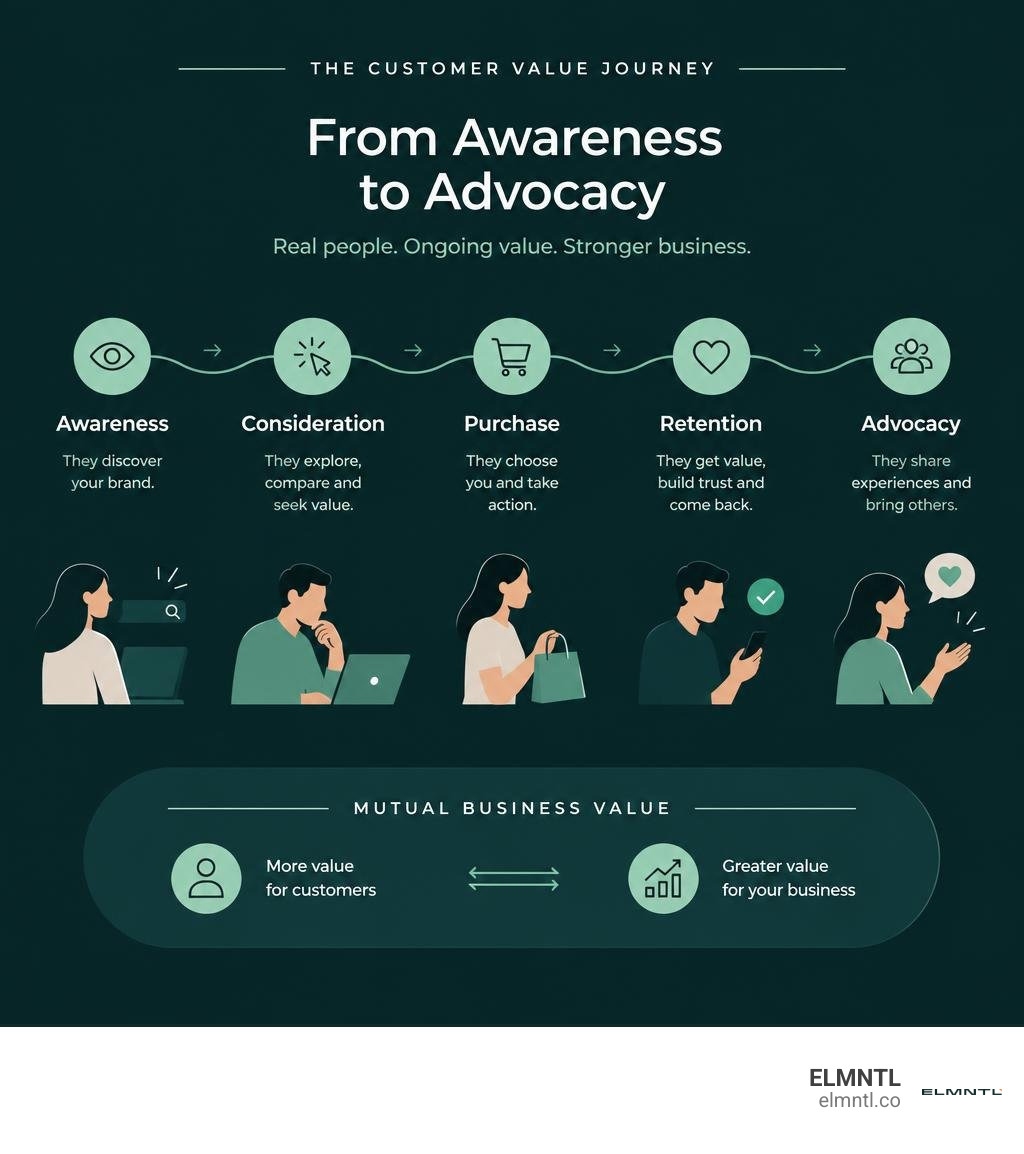
The customer value journey is a framework for aligning marketing, sales, product, and customer experience around the value people need before, during, and after they buy. It moves beyond a one-way sales funnel by asking two questions at every stage: What value does the customer receive, and what value does the business earn in return?
Use it to:
- Map the moments from first discovery through retention and advocacy.
- Find friction that slows customers down or weakens trust.
- Deliver useful, consistent messages and experiences at each touchpoint.
- Measure outcomes such as conversion, time-to-value, repeat purchase, retention, and referrals.
For brands with low visibility or uneven messaging, this matters because a great campaign cannot fix a confusing handoff, weak onboarding, or disappointing post-purchase experience. Customers may move forward, pause, skip stages, or return to research, so the journey should guide decisions without pretending every customer follows a straight line.
Common the customer value journey vocab:
What Is the Customer Value Journey?
At its core, the customer value journey represents a bidirectional exchange. Many legacy frameworks treat prospects as passive targets traveling down an extraction pipeline. In reality, modern buyers interact with brands through reciprocal relationships grounded in social exchange theory. When a brand delivers tangible functional, experiential, or symbolic value, the customer reciprocates with attention, engagement, personal data, and capital.
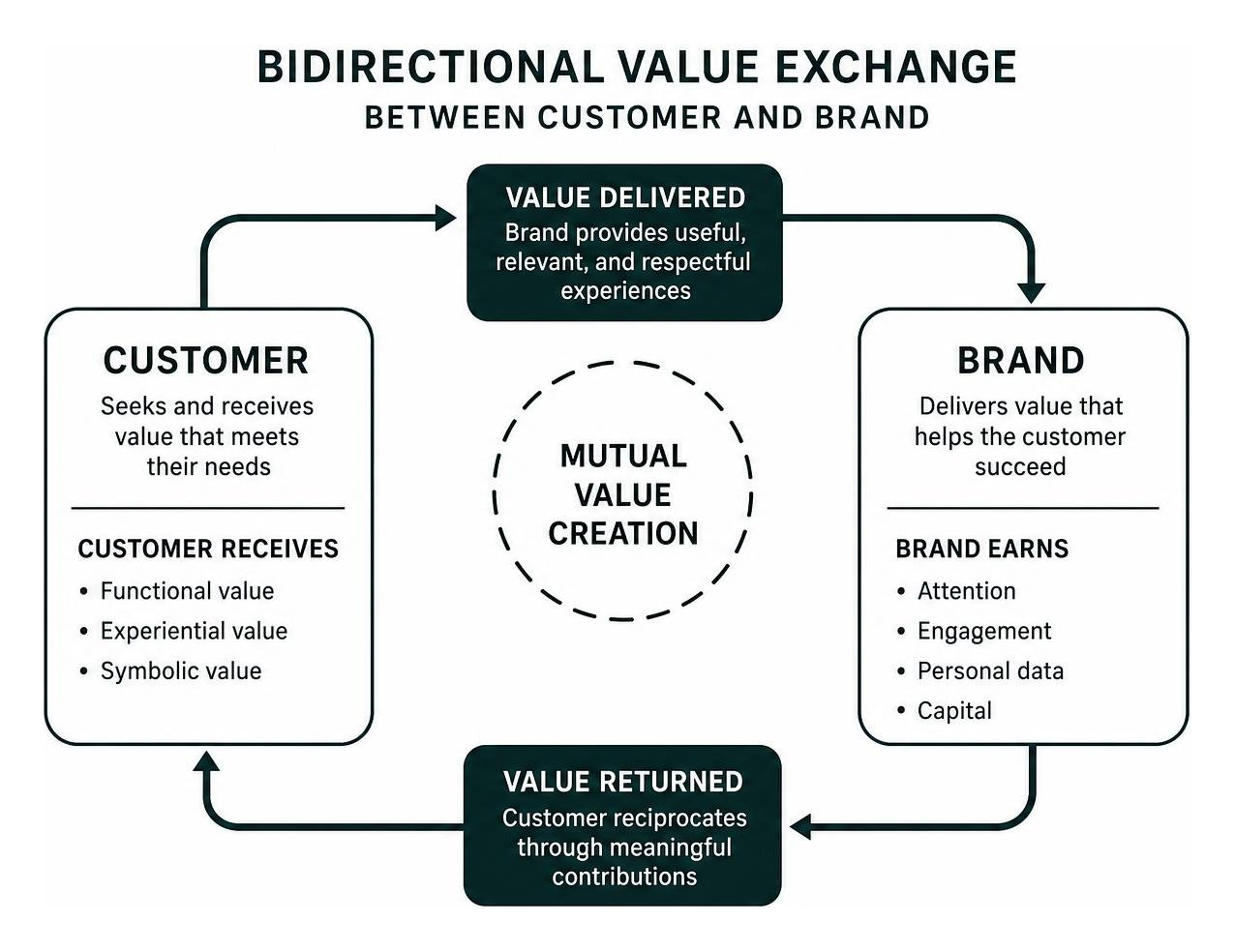
In contemporary marketing literature, this dynamic is conceptualized as Customer Journey Value (CJV). As outlined in academic research on customer journey value, this model evaluates both the firm-based outcomes (monetary revenue, referrals, customer-generated knowledge) and the customer-perceived benefits across touchpoints. Maximizing Customer Engagement Value (CEV) at every stage directly influences brand loyalty and expands Customer Lifetime Value (CLV).
When touchpoints feel natural, cohesive, and respectful of user intent, friction dissolves. We explore this concept in depth when looking at why the best customer journey always feels like second nature, proving that intuitive experiences minimize cognitive load while accelerating mutual value realization.
Evolution of the Customer Value Journey Framework
The traditional marketing funnel assumed a tidy, single-file march from awareness to conversion. That clean progression is obsolete. Today, buyer behavior is distributed, messy, and non-linear. Prospective clients hop between channels, pause for weeks to read third-party reviews, consume short-form video, and revisit product specifications before ever speaking to a sales representative.
Modern journey frameworks accommodate skips, loops, and parallel evaluation paths. Rather than forcing users down a rigid track, sophisticated brands map holistic ecosystems. To understand how to document these complex behavioral webs, review the complete guide to user journey mapping, which breaks down the tools required to track varied user paths effectively.
Key Differences Between Experience and Value Creation
It is easy to conflate Customer Experience (CX) with customer value, but they serve distinct strategic functions:
- Customer Experience (CX) describes how pleasant, seamless, and frictionless a given interaction feels.
- Customer Value Creation defines the actual utility, ROI, status, or problem resolution delivered to the buyer.
A website checkout can offer a flawless user experience, but if the product fails to solve the client’s underlying problem, zero enduring value is realized. Sustainable retention occurs only when positive experiential touchpoints pair directly with measurable value delivery.
The Core Stages of Customer Value Realization
To manage this lifecycle predictably, organizations must break down value creation into actionable, progressive phases.

| Journey Stage | Primary Customer Objective | Customer-Perceived Value | Primary Business Metric | Key Optimization Levers |
|---|---|---|---|---|
| 1. Awareness & Engagement | Discover viable solutions to unresolved pain points | Educational insights, relevant perspectives, clarity | Organic reach, impressions, average session duration, click-through rate | Targeted SEO, informative content, paid media, organic social |
| 2. Subscription & Conversion | Validate credibility with low risk | Frictionless resource access, immediate utility, trial access | Opt-in rate, micro-conversion rate, Customer Acquisition Cost (CAC) | Simplified landing pages, transparent offers, frictionless checkout |
| 3. Onboarding & Adoption | Implement the solution and verify expectations | Fast time-to-value, quick wins, onboarding clarity | Activation rate, daily/monthly active usage, onboarding completion | Guided product tours, automated check-ins, proactive support |
| 4. Retention & Advocacy | Maximize long-term results and expand capabilities | Continuous ROI, proactive advisory, community access | Net Revenue Retention (NRR), churn rate, Customer Lifetime Value, referral rate | Account reviews, loyalty incentives, customer advisory groups |
1. Awareness and Engagement
Top-of-funnel touchpoints establish baseline brand equity. During this initial discovery period, prospective buyers are not searching for aggressive sales pitches; they are seeking clarity around their existing challenges.
According to research on the impact of the customer journey on value propositions, early touchpoints heavily shape how a company’s total offering is perceived. In fact, 53% of consumers report a clear preference for brands they previously encountered during educational awareness stages, while 71% demand personalized content experiences from their first interaction. Highlighting genuine solutions through educational content marketing, search engine optimization (SEO), and targeted storytelling builds initial equity that fuels later conversions.
2. Subscription and Conversion
Once awareness is established, the goal shifts toward earning permission to engage more directly. This transition requires micro-commitments, such as subscribing to an industry newsletter, downloading a benchmark report, or attending a workshop.
When prospects are ready to make a monetary commitment, low-barrier entry offers (such as trial periods, interactive product sandboxes, or entry-level audits) mitigate perceived risk. We examine tactical ways to diagnose and optimize these website touchpoints in our guide on deciphering the customer journey on your website, showing how to remove friction from crucial conversion pathways.
3. Onboarding, Excitement, and Adoption
The transaction is not the finish line; it is the starting point of actual value realization. The period immediately following a purchase determines whether a client builds long-term loyalty or experiences buyer’s remorse.
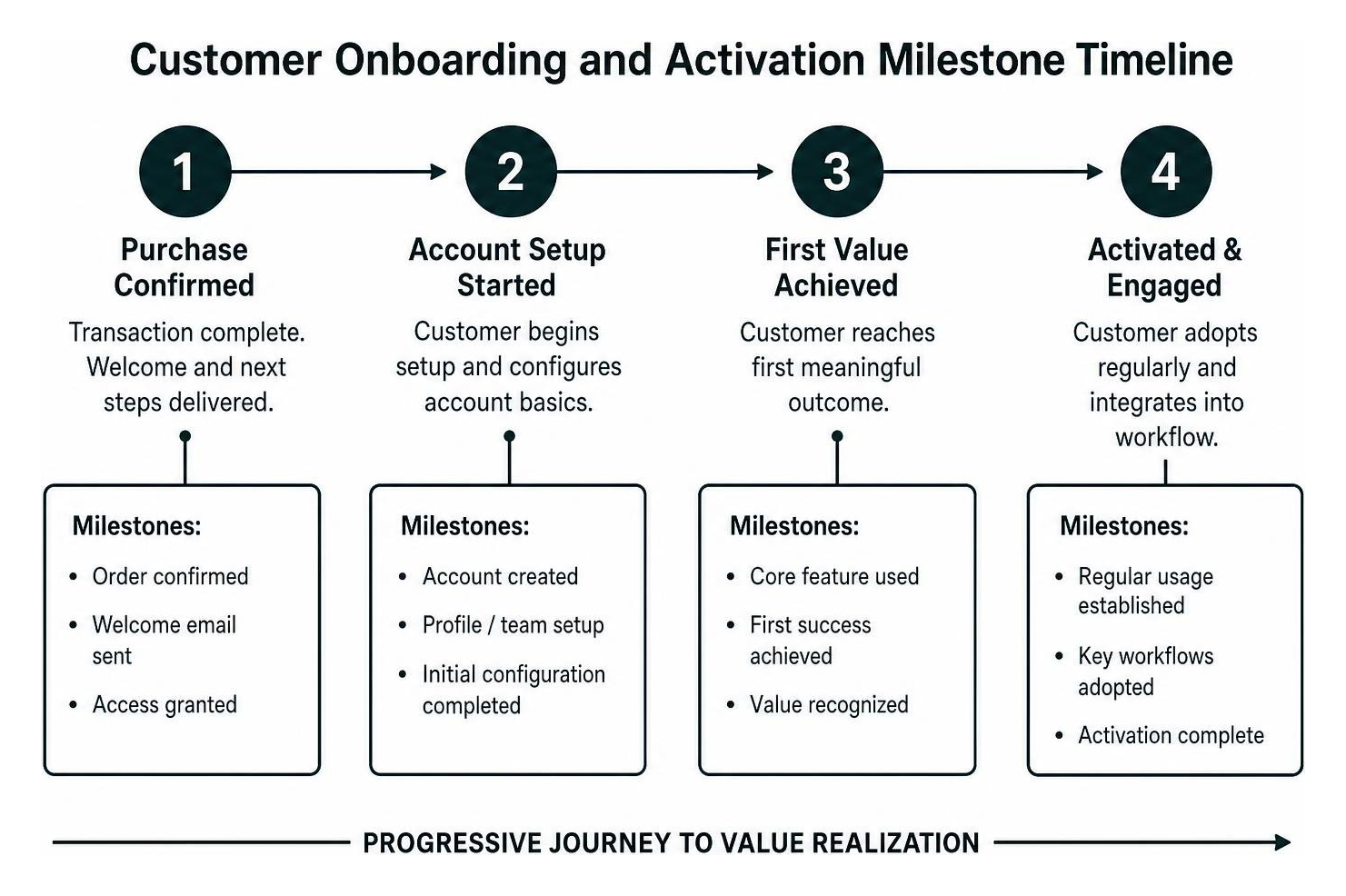
Rapid time-to-value is essential. In academic research applying lean value stream mapping to customer journeys, researchers discovered that eliminating non-value-adding delays during post-purchase steps reduced process waste by up to 96 hours, driving an approximate 15% improvement in customer satisfaction scores. By engineering seamless onboarding, automated setup assistance, and clear initial milestones, brands secure immediate product activation and deepen customer trust.
4. Retention, Expansion, and Advocacy
A durable business model relies on compounding value. Retaining an existing client costs roughly five to seven times less than acquiring a new one, making post-purchase lifecycle management a critical commercial priority.
True advocacy is not a tactical incentive program. It is the natural outcome of consistent, superior value delivery. When organizations prioritize ongoing success through optimization check-ins, feature expansion, and responsive service, clients organically transform into brand promoters. You can learn more about cultivating these long-term bonds in our article on customer journey mapping to unveil loyalty opportunities.
Integrating Value Across the Marketing and CX Lifecycle
Siloed departments break customer journeys. When marketing makes promises that sales cannot confirm, or when product onboarding ignores commitments made during the sales cycle, the customer perceives an immediate drop in value.

Unifying these departments requires shared customer visibility, integrated CRM systems, and aligned incentives. To see how to map cross-channel interactions without losing strategic focus, review our breakdown of the customer engagement journey and visualizing touchpoints.
Aligning Marketing and Experience Across the Customer Value Journey
To maintain a cohesive customer experience across all departments, organizations should implement several operational practices:
- Establish shared KPIs: Ensure marketing, sales, and customer success share visibility into activation rates, Net Revenue Retention (NRR), and customer lifetime health rather than isolated volume metrics.
- Systematize value documentation: Keep detailed CRM records of the exact outcomes, pain points, and strategic goals articulated by the client during early sales conversations to ensure onboarding teams deliver on those expectations.
- Maintain unified messaging: Audit automated lifecycle emails, sales collateral, and support documentation so the brand voice and core value proposition remain uniform across every channel.
Eliminating Friction and Journey Waste
Every unnecessary form field, delayed email response, broken link, or repetitive qualification call represents journey waste. These friction points erode the customer’s perceived value and drive premature drop-offs.
Eliminating these obstacles requires rigorous qualitative and quantitative investigation. Rather than relying on internal assumptions about why users abandon carts or fail to renew, teams should ground their process optimization in structured data collection. For an actionable framework on gathering user feedback, check out our guide on how to conduct research for journey mapping.
Measuring Success and Customer Journey Value
Measuring lifecycle value requires looking beyond surface-level conversion rates to monitor longitudinal indicators of mutual growth.
Key performance metrics include:
- Customer Lifetime Value (CLV): The total net profit generated across the entire duration of a customer relationship.
- Customer Acquisition Cost (CAC) Payback Period: The duration required for a customer to generate sufficient gross margin to repay the cost incurred to acquire them.
- Time-to-Value (TTV): The elapsed time between contract signing (or purchase) and the moment the user experiences their first measurable business benefit.
- Net Revenue Retention (NRR): The percentage of recurring revenue retained from existing customers over a specific window, factoring in upgrades, downgrades, and churn.
- Customer Engagement Value (CEV): A composite evaluation that measures transactional spend alongside referral generation, content engagement, and co-creation feedback.
Frequently Asked Questions About the Customer Value Journey
How does the customer value journey differ from a traditional sales funnel?
A traditional sales funnel is linear and concludes at the point of transaction. It focuses heavily on how a business extracts capital from a buyer. In contrast, the customer value journey is a cyclical, bidirectional framework that prioritizes ongoing value delivery before, during, and well after the initial purchase, placing equal emphasis on retention, adoption, and advocacy.
What metrics best track customer value across the lifecycle?
The most effective metrics assess both velocity and compounding retention. Primary indicators include Time-to-Value (TTV), Customer Lifetime Value to Customer Acquisition Cost ratio (CLV:CAC), Net Revenue Retention (NRR), churn rate, and organic customer referral rates.
Why do brands struggle to scale customer advocacy?
Brands often struggle to generate advocacy because they treat it as an isolated marketing campaign, like offering small gift cards for reviews, rather than recognizing it as the natural outcome of outstanding service. When companies over-invest in acquisition and under-invest in post-purchase onboarding and ongoing customer success, client enthusiasm fades before advocacy can take root.
Conclusion
Building a high-performing digital brand requires looking past isolated campaign metrics and committing to a continuous, value-first customer lifecycle. When you align your messaging, digital architecture, and post-purchase touchpoints around the exact outcomes your buyers care about, sustainable growth and genuine brand loyalty follow naturally.
At ELMNTL, we help organizations engineer seamless customer journeys through integrated marketing, custom web design and development, and data-backed brand strategy. Explore our integrated marketing and journey optimization services to turn your customer experience into a predictable engine for long-term growth.