

Choose a White Label Site Platform That Can Grow With You
A white label site platform lets you sell website creation under your own brand while another company runs the software and infrastructure. For freelancers and growing agencies, the best choice is usually the one that gives you full branding control, simple client permissions, reliable SEO and e-commerce tools, and pricing that stays profitable as your client list grows.
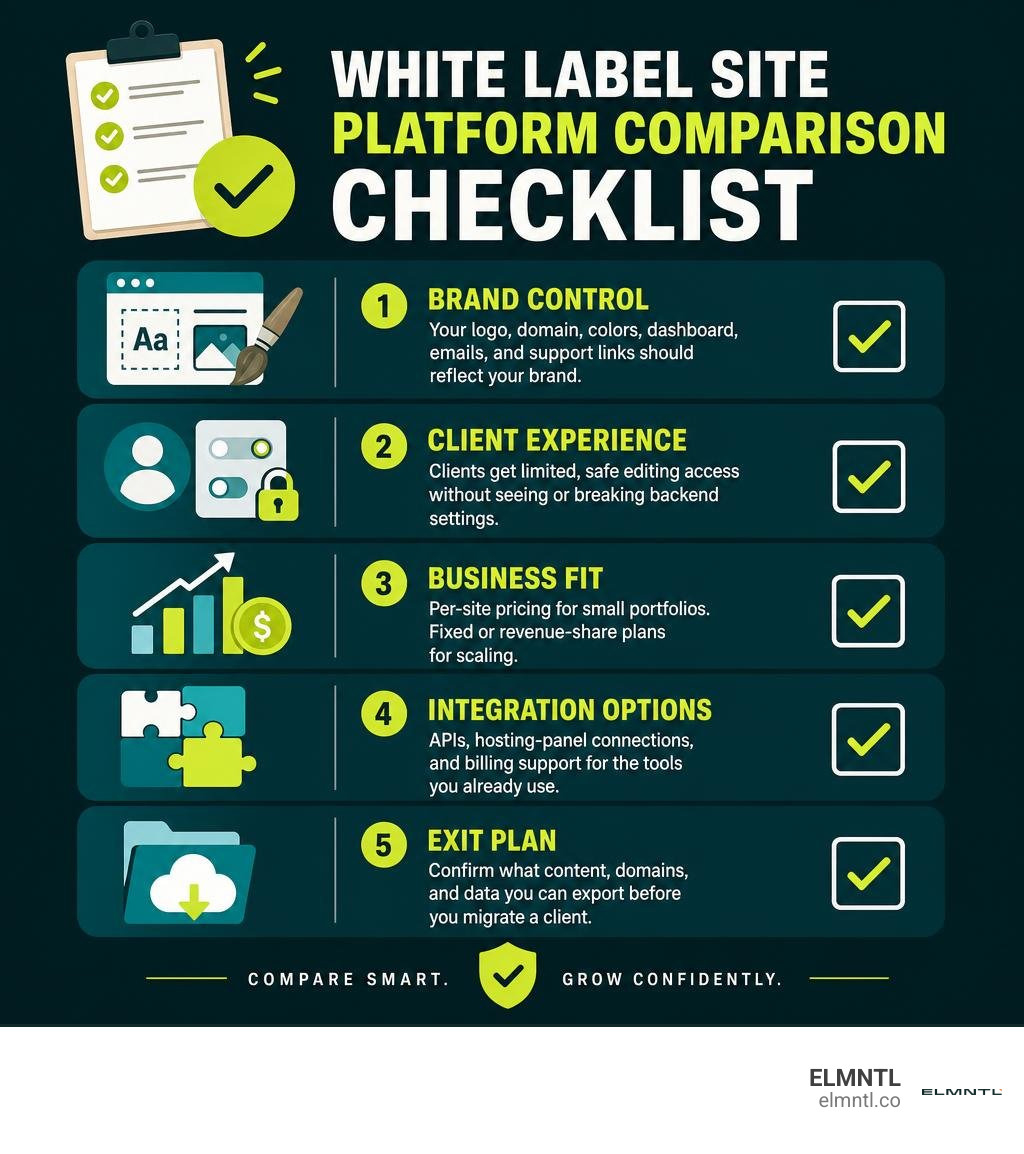
Before choosing a platform, check these essentials:
- Brand control: Your logo, domain, colors, dashboard, emails, and support links should replace the vendor’s branding.
- Client experience: Clients need safe, limited editing access without seeing or breaking backend settings.
- Business fit: Per-site pricing can suit a small portfolio, while fixed or revenue-share plans may work better at scale.
- Integration options: APIs, hosting-panel connections, and billing support matter if you use tools such as cPanel, Plesk, WHMCS, or Blesta.
- Exit plan: Confirm what content, domains, and data you can export before you migrate a single client.
Unlike a standard website builder, a true white-label platform is designed for resale. It helps you package websites, hosting, maintenance, and marketing services into recurring plans, while keeping your brand at the center of the relationship.
At ELMNTL, we help brands turn digital strategy, web design, and integrated marketing into measurable growth. Our experience with white label site decisions comes from building scalable digital experiences and advising businesses on the systems that support stronger customer engagement.
White label site further reading:
Core Architecture of a Modern White Label Site Platform
The fundamental concept of a white-label product originated in physical manufacturing, where a single producer supplies goods that different retailers rebrand with their own trade dress. In the modern software landscape, this concept has evolved into sophisticated multi-tenant cloud platforms. Instead of engineering proprietary CMS engines from the ground up, digital professionals use turnkey software to provide full-service web experiences under their own agency umbrella.
For technical teams evaluating options, the architectural path often splits between proprietary no-code platforms and bespoke systems. While enterprise organizations might invest in custom CMS development for niche application needs, turnkey white-label builders provide immediate operational leverage. They bundle visual site editing, multi-tenant database management, automated SSL deployment, and continuous security patching into a single managed infrastructure.
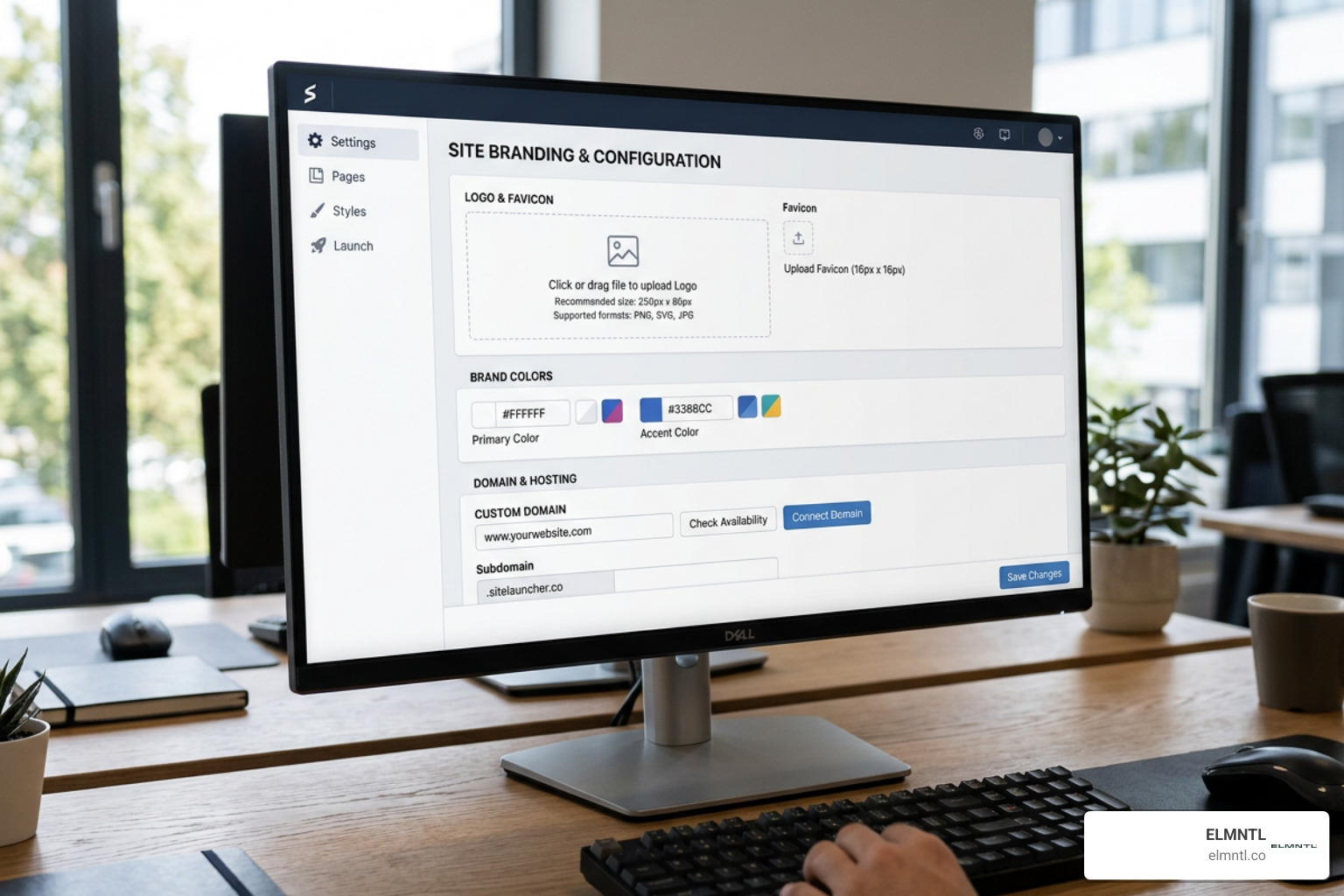
Complete brand isolation requires that every technical touchpoint reflects your agency identity. True white-label software ensures that the underlying technology vendor remains completely invisible to your clients across every screen, link, and automated message.
Standard Website Builders vs. White-Label Platforms
Standard consumer website builders focus entirely on individual site owners. When you build a site using an off-the-shelf retail tool, the vendor places their logo on the login screen, sends automated system updates featuring their corporate branding, and directs support queries back to their own knowledge base. This creates severe vendor leakage for freelancers and agencies, as clients immediately realize you are acting as an intermediary for a retail product.
A dedicated white-label platform transforms this workflow. You gain access to customizable platform skins, dedicated client login portals hosted on your custom domain, and isolated account permissions. This structure allows your clients to edit text, upload images, or review sales metrics inside a dashboard that appears entirely built, maintained, and operated by your business.
Essential White Label Site Features for Client Portals
When assessing candidate platforms, prioritize features that safeguard your workflow and support your agency positioning:
- Custom Domain Mapping and SSL: The client dashboard, staging previews, and public sites must resolve securely under your own domain names (e.g.,
portal.youragency.com) with automated SSL provisioning. - Complete Visual Rebranding: Ensure you can upload custom logos, set primary interface color palettes, customize favicons, and remove all default vendor footer badges. This level of visual polish is foundational to building a strong brand identity that builds lasting credibility with your client base.
- Granular Role-Based Permissions: Your team needs complete backend control, while clients should receive limited access. Locking structural grids, scripts, and CSS styling ensures clients can edit basic content without corrupting responsive layouts or breaking technical SEO tags.
- Unbranded Onboarding and Email Masking: High-tier platforms provide non-branded video academies and training tutorials alongside custom SMTP support. This ensures that every welcome email, password reset, or performance update originates directly from your agency’s domain.
Evaluating Pricing Models and Commercial Scalability
White-label platforms structure their billing across three distinct commercial models. Choosing the right pricing architecture depends heavily on your current client volume, technical resources, and growth targets.
- Fixed Monthly or Annual Plans: Platforms such as IM Creator ($500/month for unlimited sites) or Simvoly ($59/month up to $429/month for unlimited sites and funnels) charge a predictable platform fee. These plans reward high-volume agencies because your operational margins expand rapidly with every new website you launch.
- Per-Site Tiered Pricing: Platforms like Duda ($149/month for four sites, with additional sites at approximately $14 each) and Brizy Cloud ($159/month for ten sites, with add-ons around $8/month) scale directly with your active client base. This keeps overhead low for solo practitioners while ensuring predictable hosting expenses.
- Revenue-Share and Micro-Pricing Models: Infrastructure solutions like Site.pro offer reseller models where hosting partners earn a 50% revenue share on upgrades, or purchase base sites for fractions of a dollar at high volume.
Carefully matching your software overhead to managed web services ensures your business retains healthy profit margins across both one-off design fees and recurring monthly retainers.
| Pricing Model | Typical Cost Structure | Best Suited For | Key Commercial Advantage |
|---|---|---|---|
| Fixed Platform Fee | $89 – $500 / month flat | High-volume agencies & SaaS | Predictable overhead; margins increase with scale |
| Per-Website Model | $8 – $14 / site / month | Freelancers & boutique studios | Low upfront cost; zero cost penalty for smaller client lists |
| Revenue-Share Model | 50% split or usage micropayments | Web hosting providers & registrars | Zero financial barrier to entry; monetizes client upgrades automatically |
Platform Selection by Business Type
Different organizational models demand different technical capabilities:
- Freelance Web Designers: Solo designers benefit most from visual, design-led tools such as WebWave, Brizy Cloud, or Weblium. These platforms emphasize drag-and-drop flexibility, rapid page building, and bundled hosting so freelancers can launch high-converting projects quickly without managing servers.
- Digital Marketing Agencies: Marketing teams often require more than standalone websites. Platforms like Simvoly or Duda provide integrated conversion funnels, native appointment scheduling, email automation, and white-label client academies, turning simple web design into a complete digital ecosystem.
- Web Hosting Providers and Resellers: Hosting companies require deep infrastructure integration. Tools like Site.pro and BaseKit integrate directly with cPanel, Plesk, and billing managers like WHMCS or Blesta, letting hosting companies bundle easy site building directly into their hosting tiers.
- SaaS Platforms: Product teams wanting to embed site-creation features into existing software require robust REST APIs and Single Sign-On (SSO) capabilities.
While these tools offer turnkey speed, businesses with complex requirements or large enterprise footprints often balance white-label platforms alongside professional custom web design services to address specialized architectural demands.
Operational Workflows and System Integrations
Integrating a white-label site engine into your day-to-day operations should simplify, not complicate, your tech stack. Modern platforms provide deep REST API connectivity, allowing you to connect client onboarding forms directly to your CRM, payment gateways like Stripe, and project management dashboards.
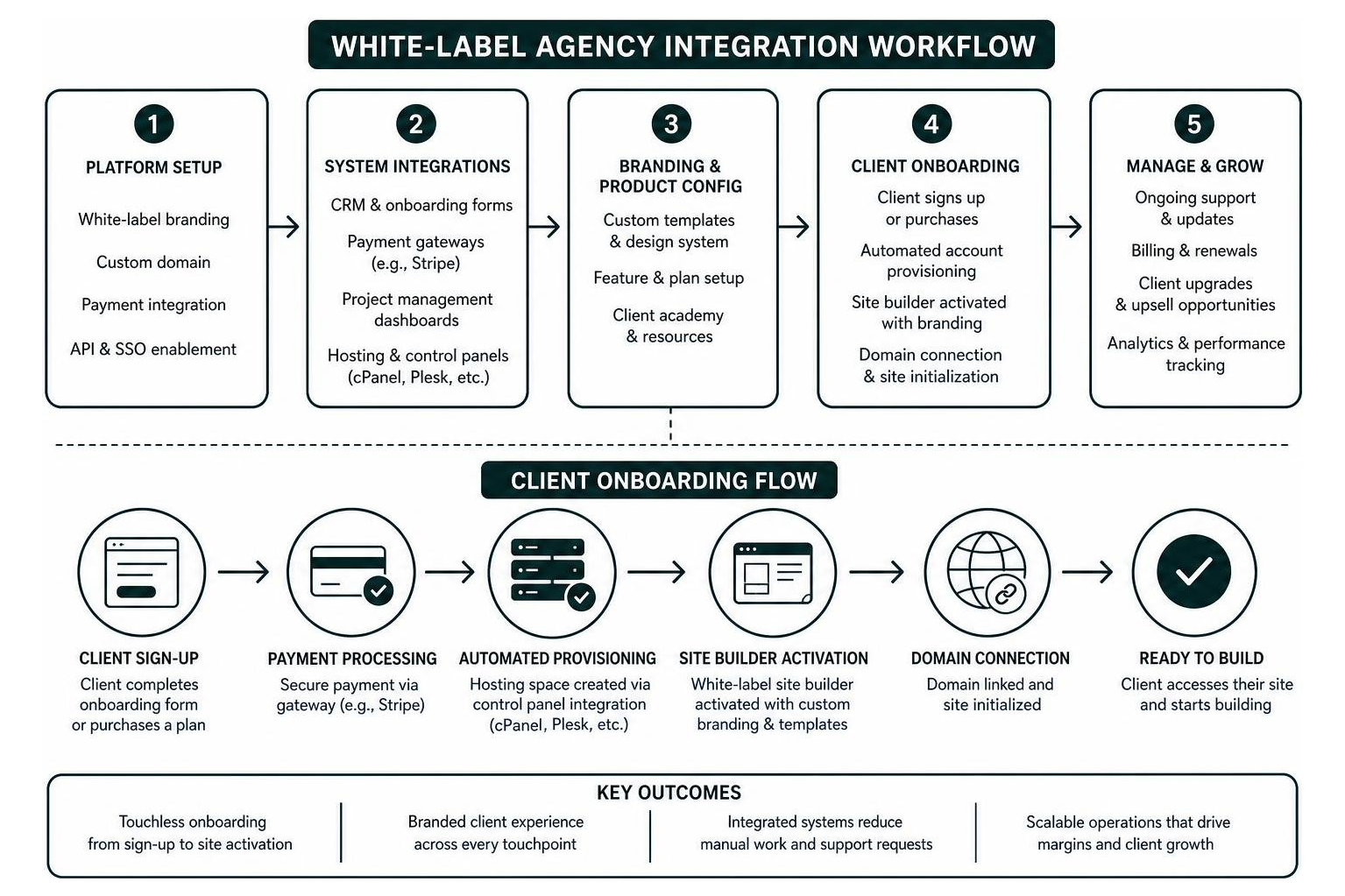
For hosting companies, native compatibility with control panels like cPanel, Plesk, DirectAdmin, and Webuzo is essential. When coupled with automated billing software such as WHMCS or Blesta, customer provisioning becomes entirely touchless. A customer purchases a subscription, their hosting space initializes, the white-label site builder activates with custom skins, and their domain links automatically.
Ensuring your builder natively supports responsive layouts, clean code output, and fast loading speeds is vital for optimizing every stage of the web user journey. Modern platforms also incorporate generative AI tools directly inside the builder. These allow you or your end clients to create full page layouts, generate industry-specific copy, and adjust styling using real-time conversational prompts in under thirty seconds.
How to Migrate Existing Projects to a White Label Site Builder
Transitioning an existing portfolio of client websites onto a consolidated platform can feel daunting, but centralized infrastructure saves hundreds of hours of maintenance down the line.

Many white-label providers now feature automated import engines capable of scraping and converting pages from legacy systems like WordPress, Weebly, or Wix directly into their visual editors. When executing a migration, follow a structured procedure:
- Audit and Content Extraction: Export site maps, media assets, and existing metadata. Ensure canonical tags and 301 redirect mappings are prepared to protect current search engine equity.
- Bulk Import and Layout Quality Assurance: Use the platform’s automated migration scripts to ingest layout structures. Review mobile responsive breakpoints, verify form webhook integrations, and confirm font rendering across desktop and mobile browsers.
- DNS Re-pointing and SSL Generation: Update domain records to target the white-label platform servers. Most platforms automatically issue and renew Let’s Encrypt SSL certificates the moment DNS propagation completes.
- Client Handoff and Support Onboarding: Introduce clients to their newly branded portal with pre-configured permissions. Coupling this transition with clear, ongoing website support reassures clients that their digital assets remain in safe hands.
Frequently Asked Questions About White Label Platforms
Can clients tell that a website was built using a third-party platform?
If your platform is properly configured, clients will not be able to identify the underlying technology vendor. High-grade white-label systems remove all third-party branding from admin dashboards, staging URLs, system notification emails, and browser favicons. The platform presents your custom domain and agency branding exclusively across every client-facing touchpoint.
What are the main limitations and risks of white-label website builders?
The primary risks involve proprietary code lock-in and reduced low-level technical control. Most SaaS website builders do not permit you to export raw backend database files or server-side scripts. If you decide to leave the platform in the future, you may have to rebuild pages manually on your new system. Additionally, complex custom database logic or specialized third-party software integrations can be restricted compared to open-source environments.
How does AI website generation work within a white-label dashboard?
AI tools within modern white-label platforms use natural language processing to produce functional website drafts from simple text prompts. Internal teams or end clients input their business category, geographic location, and desired features, and the AI engine automatically builds a multi-page site with tailored layouts, relevant stock imagery, and drafted copy in seconds. These elements remain fully editable within the visual drag-and-drop workspace.
Conclusion
Adopting a white-label site platform provides freelancers and digital agencies with a sustainable, scalable operational model. By pairing high-performance, turnkey infrastructure with your own agency branding, you can eliminate technical maintenance debt, shorten client turnaround times, and establish predictable monthly recurring revenue.
At ELMNTL, we help organizations streamline their technical operations and build strong market visibility. Whether you are refining your digital fulfillment strategy or looking to elevate your brand presence through our comprehensive digital services, selecting the right infrastructure today sets the foundation for your long-term commercial growth.