

The Core Architecture of Java Website Development
Building web applications in Java requires a solid understanding of how server environments operate. When you develop for the browser, your code does not run on the client machine in isolation. Instead, it lives inside a server runtime that listens for incoming network traffic, parses web requests, and coordinates business logic before returning data back to the user.
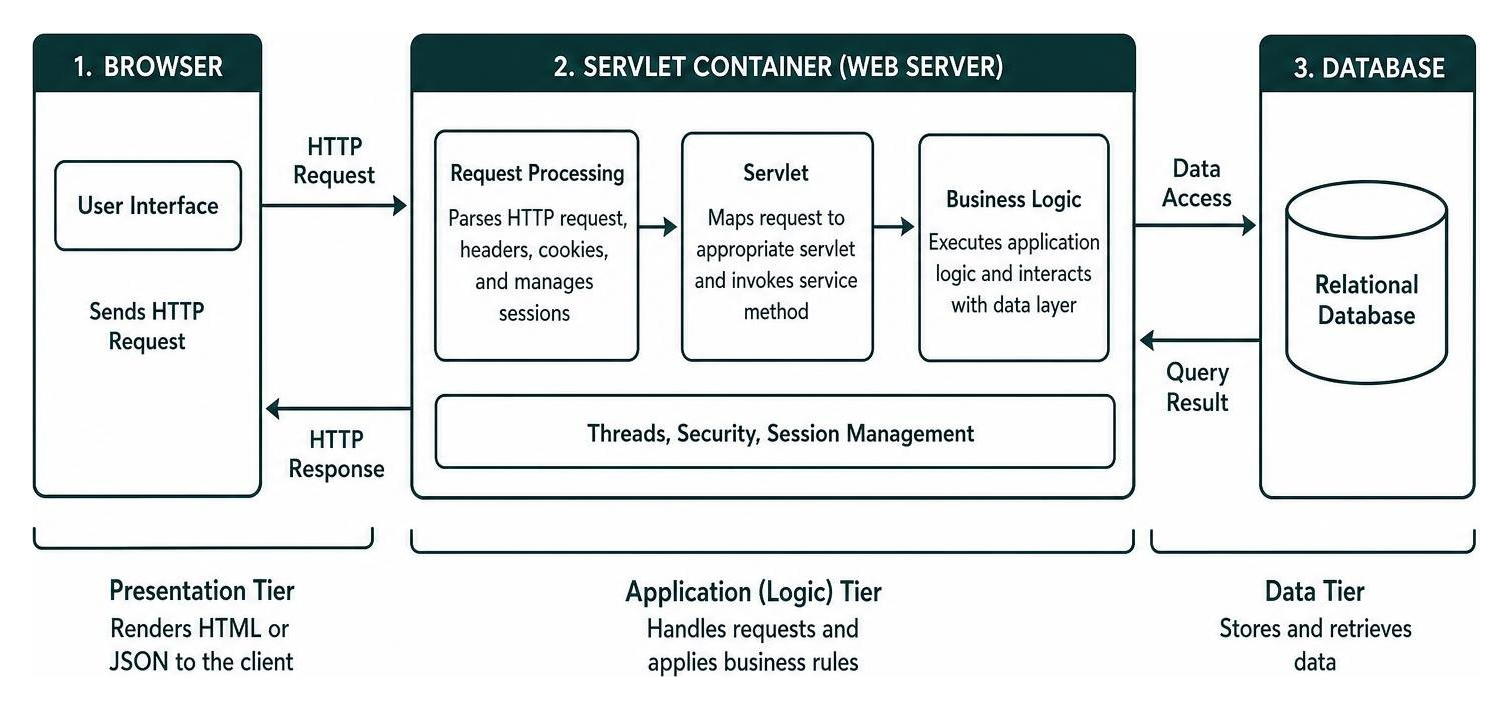
At the heart of standard Java web applications is the servlet container, such as Apache Tomcat. Jakarta EE standards define how these web servers receive HTTP requests and pass them to specific Java servlets. Rather than managing raw network sockets manually, your application relies on the container to parse HTTP headers, manage cookies, and track sessions across multiple page visits.
Most Java applications follow a three-tier architecture:
- Presentation Tier: Manages user interfaces, whether rendering dynamic HTML on the server or transmitting JSON payloads to a client browser.
- Application (Logic) Tier: Houses the core business rules, service layers, and domain logic.
- Data Tier: Connects to relational databases, caches, or cloud storage systems through structured drivers and persistence engines.
Understanding Java Web Architecture vs Desktop Programming
For developers transitioning from traditional desktop Java programming (using Swing or JavaFX), the mental shift to web computing centers on the communication model. Desktop software runs locally with long-lived processes, maintaining active state directly in memory as long as the window remains open. UI events like button clicks fire internal desktop event loops that mutate state on that single machine.
Web applications, however, are fundamentally stateless and distributed. Every interaction follows a strict request-response lifecycle over HTTP. The server must handle thousands of concurrent users simultaneously without mixing up their session data or leaking memory. To build high-traffic platforms, teams apply patterns designed for building a scalable enterprise website where load balancing, thread pooling, and stateless service design prevent server bottlenecks.
Key Business Advantages of Java Website Development
Java remains a top choice for organizations worldwide, powering everything from banking portals to large-scale ecommerce. Java holds an 8.54% market share on the TIOBE index and represents approximately 29.4% of the global programming language market. Having celebrated its 30th anniversary, the platform combines battle-tested stability with cutting-edge runtime performance.
Key advantages include:
- Write Once, Run Anywhere (WORA): The Java Virtual Machine (JVM) abstracts underlying hardware and operating systems, allowing reliable deployment across AWS, Google Cloud, Azure, or private Linux clusters.
- Strict Type Safety and Maintainability: Strong static typing catches structural errors at compile time, saving development teams countless debugging hours across enterprise codebases.
- Modern Concurrency via Virtual Threads: Introduced through Project Loom in modern Java releases (Java 21 and later), virtual threads allow lightweight, high-throughput concurrency. Blocking network calls no longer monopolize heavy OS-level threads.
- Enterprise-Grade Security: The platform features robust memory safety, active garbage collection, strict access modifiers, and proven security frameworks that safeguard against memory corruption vulnerabilities.
| Feature / Metric | Java (Spring Boot) | PHP (Laravel / Modern PHP) | Python (Django / FastAPI) |
|---|---|---|---|
| Primary Execution Model | JVM multi-threaded / Virtual threads | Process-based / FastCGI workers | Async event loops / WSGI / ASGI |
| Type System | Static, strongly typed | Dynamic (with optional strict types) | Dynamic (with type hints) |
| Concurrency Scale | Exceptional (millions of concurrent tasks) | Moderate (resource-heavy per worker) | High with async; moderate with sync WSGI |
| Enterprise Adoption | Extremely High (banking, telecom, SaaS) | High (content sites, CMS platforms) | High (data science, AI services, APIs) |
| Memory Footprint | Moderate to High (JVM baseline) | Low per request | Moderate |
Essential Java Web Frameworks: Spring Boot and Modern Alternatives
While basic Java servlets handle fundamental web requests, writing raw servlets for large sites leads to repetitive boilerplate code. Modern developers rely on frameworks to organize routing, handle dependency injection, and manage database transactions automatically.

Spring Boot and Enterprise Microservices
Spring Boot is the standard framework for enterprise Java web applications. It simplifies the Spring ecosystem by providing opinionated defaults, embedded servlet containers like Tomcat or Jetty, and automatic configuration.
The platform provides comprehensive solutions for modern web backends:
- Spring MVC: Implements the Model-View-Controller pattern for web routing, REST controller mapping, and request handling.
- Spring Security: Provides declarative authentication, authorization, OAuth2 integration, and automatic defenses against CSRF and session fixation attacks.
- Spring Data: Reduces data access boilerplate by generating repository implementations directly from Java interfaces.
For teams building microservice architectures or distributed platforms, Spring Boot integrates smoothly into API-driven workflows. When designing modern service boundaries, following best practices for seamless API integration web development ensures consistent data contracts and reliable communication between independent services.
Component-Based and Pure Java Web Frameworks
While Spring Boot dominates traditional REST and MVC development, the Java ecosystem includes several specialized frameworks designed to build complete web applications using pure Java:
- Apache Wicket: Active since 2004, Apache Wicket is a component-oriented framework that separates HTML markup from Java code. It lets developers build dynamic pages using pure Java objects and clean HTML without complex script integrations.
- Vaadin Java Web Framework: Loved by over 100,000 developers, Vaadin allows teams to write rich web front ends entirely in Java. It handles UI rendering, server push, and browser communication automatically. For hybrid development, the Hilla framework pairs a Spring Boot backend with reactive TypeScript front ends.
- RIFE2 modern Java web framework: A zero-dependency, full-stack framework contained in a single 2.5 MB JAR. RIFE2 leverages Java virtual threads by default and uses logic-less templates and type-safe routing. You can explore the source code via the rife2/rife2 repository.
- Oorian Core Framework: A full-featured server-side framework designed to eliminate JavaScript dependencies. It uses a JDK-style event model to generate dynamic HTML, handle CSS3 styling, and process events entirely in Java.
Database Connectivity: Transitioning from File I/O to JDBC and Hibernate
In desktop programming, simple applications often store settings and data in local text files, JSON documents, or XML configuration files. In a multi-user web application, traditional file I/O causes major issues. If two web users attempt to write to a flat file at the same instant, file locking errors or silent data corruption occur.
Web backends solve this concurrency challenge by connecting to relational database management systems like PostgreSQL, MySQL, or Oracle. These database engines provide ACID (Atomicity, Consistency, Isolation, Durability) guarantees, handling thousands of concurrent read and write transactions reliably.
Step-by-Step Guide to Java Website Development for Beginners
Getting started with a modern Java web application takes only a few clear steps:
- Install the JDK: Download and install a modern Java Development Kit (JDK 21 or later) to take advantage of virtual threads and recent language features.
- Choose an IDE: Install an integrated development environment such as IntelliJ IDEA or Eclipse configured for Java development.
- Initialize the Project: Use Spring Initializr or your build tool of choice (Maven or Gradle) to generate a basic project skeleton with Spring Web and Spring Boot Starter dependencies.
- Create a Controller: Write a Java class annotated with
@Controlleror@RestControllerto define your first web endpoint. - Implement Data Storage: Connect your application to a database using Spring Data JPA or JDBC.
- Design the UI: Build clean views using templates or client-side components, applying key lessons from the developer’s guide to not building ugly websites to ensure responsive, intuitive user interfaces.
- Run and Test: Execute your application via your build tool, open your browser to
http://localhost:8080, and verify your endpoints.
Modern Data Persistence with JDBC, JPA, and Hibernate ORM
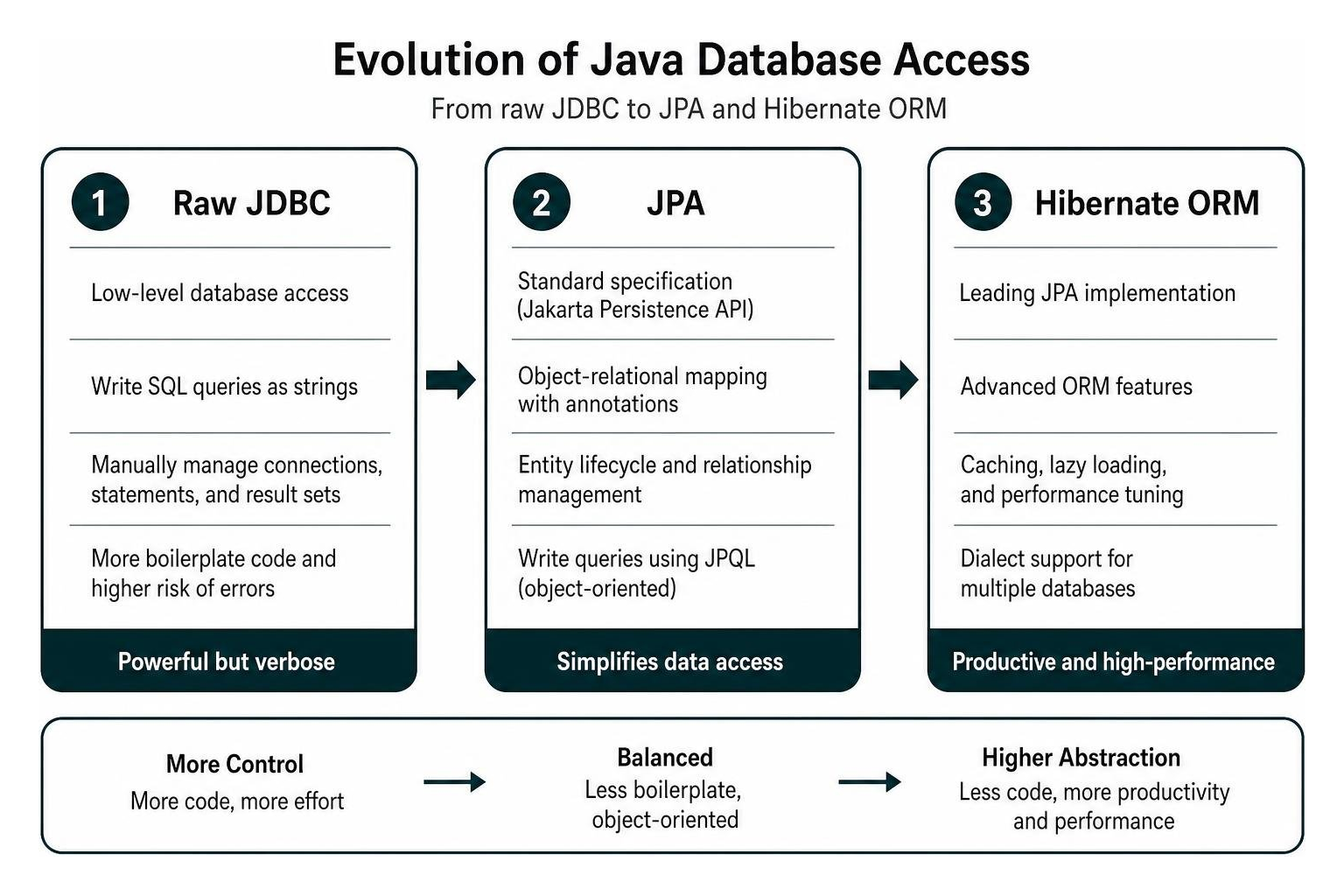
Java provides three primary layers for database interaction:
- JDBC (Java Database Connectivity): The low-level standard API that connects Java code to relational databases using database drivers. Developers use
PreparedStatementto run SQL queries safely and protect against SQL injection vulnerabilities. Connection pools like HikariCP manage active database connections to avoid connection latency. - JPA (Jakarta Persistence API): A specification that defines how Java objects map to relational database tables using standard annotations like
@Entity,@Id, and@Table. - Hibernate ORM: The most widely used implementation of JPA. It automates SQL query generation, handles table relationships (one-to-one, one-to-many, many-to-many), and manages multi-level caching strategies.
| Technology | Level of Abstraction | Boilerplate Code Required | Performance Control | Best Use Case |
|---|---|---|---|---|
| JDBC | Low-level direct SQL | High (manual mapping of result sets) | Maximum fine-grained control | High-speed batch processing, complex analytical queries |
| JPA | Standard Specification | Low to Moderate | High (depends on provider) | Enterprise applications needing vendor-neutral ORM standards |
| Hibernate | Full ORM Implementation | Low (automatic schema and query generation) | High (with proper query tuning and fetch plans) | Complex domain models, standard CRUD web applications |
Frontend Integration: Traditional Server-Side Rendering vs. Modern Single-Page Apps
When developing a Java-powered website, teams choose between server-side rendering (SSR) and client-side single-page applications (SPAs) connected via REST or GraphQL APIs.

Server-Side Rendering with JSP and Thymeleaf
Server-side rendering generates full HTML documents directly on the server before transmitting them to the user’s browser:
- Jakarta Server Pages (JSP): The classic Java view technology. While still found in legacy applications, JSP mixes raw scriptlets with HTML, making modern UI maintenance challenging.
- Thymeleaf: The modern standard for server-rendered Spring applications. Thymeleaf templates are fully valid HTML5 files that can be previewed directly in a browser. It integrates cleanly with Spring MVC, processing dynamic data attributes on the server.
SSR delivers fast initial page loads and clean markup, which benefits search engine visibility and accessibility. Furthermore, building dynamic templates on the server makes it straightforward to manage localized content by following multilingual website development best practices for international audiences.
Decoupled Single-Page Applications with React and Angular
For applications that require dynamic user dashboards and instant state updates, decoupling the Java backend from the frontend is an effective pattern. In this architecture:
- The Java backend functions exclusively as a secure, stateless API layer built with Spring Boot REST controllers.
- The user interface is built with modern frontend frameworks such as React, Angular, or Vue.js using TypeScript.
- Data transfers between frontend and backend take place via lightweight JSON payloads over HTTPS, with Spring Security managing CORS (Cross-Origin Resource Sharing) headers, JWT verification, and rate limiting.
This separation allows design and engineering teams to work independently while creating polished interfaces. Pairing a dependable Java backend with custom web design services ensures the final product aligns with brand guidelines and delivers an intuitive user experience.
Frequently Asked Questions About Java Web Development
Can beginners build modern websites with Java without complex configurations?
Yes. In the past, Java web development required extensive XML configurations, manual servlet setups, and complex application servers like JBoss or WebLogic. Today, Spring Boot and modern frameworks like RIFE2 provide starter templates and sensible defaults. Beginners can generate a working project online, open it in an IDE, and start writing web routes with just a few lines of code.
How do Java virtual threads improve website performance under high traffic?
Introduced in Java 21 via Project Loom, virtual threads are lightweight threads managed directly by the JVM rather than the underlying operating system. Traditional Java web servers allocate one OS thread per incoming request, which consumes memory and limits concurrency to a few thousand simultaneous connections.
Virtual threads allow servers to create millions of active threads with minimal memory overhead. When your code waits for a database query, file access, or third-party API response, the JVM parks the virtual thread and assigns the underlying processor to other tasks. This model delivers high throughput without requiring complex asynchronous code.
Is Java still relevant for web development compared to Node.js and Python in 2026?
Java remains one of the most reliable and high-performing choices for web and cloud development. While Node.js and Python excel at fast prototyping and lightweight scripts, Java provides superior execution speed, robust type safety, and unmatched long-term maintainability for large systems. With native GraalVM image compilation, rapid release cycles, and modern language features, Java powers mission-critical enterprise web platforms across the globe.
Conclusion
Java web development continues to balance stability with modern engineering practices. Whether you choose Spring Boot to create resilient microservice backends, Thymeleaf for clean server-rendered templates, or a pure Java framework like Vaadin, the JVM platform provides the tooling and concurrency needed to build dependable web applications.
At ELMNTL, we help businesses build scalable, user-focused digital experiences that support long-term growth. If you are planning a modern web platform or exploring content architecture options, take a look at our complete guide to custom CMS development to discover how to align your backend infrastructure with your strategic business goals.