

Why Website Traffic Intelligence Drives Smarter Growth
To check website traffic of competitors, start by entering a target domain into a traffic estimation tool such as Similarweb, Semrush, or Ahrefs. Review the domain’s total visits and six to twenty-four month trendline, then break down its acquisition channels, including organic search, paid search, direct, social, referral, and email. Finally, audit the top pages and keywords driving that traffic so you can identify content gaps and high-intent opportunities for your own site.
Building a marketing strategy without analyzing competitor performance is like driving with a fogged windshield. You might know your speed and fuel levels, but you cannot see the vehicles passing you or the shortcuts they take. When we evaluate competitor traffic data, we shift from reactive guesswork to proactive market positioning.
Traffic benchmarking provides context for your internal metrics. If your organic traffic grew by 5% this quarter, that seems positive in isolation. However, if your top three competitors grew their traffic by 35% during the same window, your market share actually contracted. Using a reliable traffic analysis website allows you to establish realistic performance baselines and uncover where industry demand is surging.
Analyzing digital intelligence helps you optimize your marketing budget. Instead of spreading ad spend thinly across every channel, you can inspect where rivals invest heavily and sustain long-term engagement. If a competitor pours significant budget into specific paid search terms month after month, those terms are likely delivering a return. Conversely, uncovering channels they neglect, such as high-intent long-tail organic search or niche referral domains, reveals low-competition avenues for your brand to dominate.
Estimating Accuracy and How Data Modeling Works
Third-party analytics tools do not have direct access to a competitor’s private server logs or analytics accounts. Instead, they use complex predictive modeling that combines multiple data sources:
- Direct measurement: Anonymized data sets shared directly from websites, apps, and opt-in measurement panels.
- Contributory networks: Aggregate behavioral clickstream data collected from browser extensions, desktop software, and mobile apps.
- Data partnerships: Global internet service provider (ISP) feeds and telecommunications network data.
- Public data extraction: Automated indexing of search engine results pages (SERPs), social networks, and backlink graphs.
Because these tools rely on statistical modeling, estimation accuracy varies by site size. Data intelligence studies, including research by SparkToro, indicate that tools like Similarweb achieve their highest accuracy on mid-tier domains receiving between 5,000 and 100,000 monthly Google Analytics visitors.
On smaller websites with fewer than 5,000 monthly visits, the sample size is often too limited, leading to wider estimation margins. For massive enterprises with tens of millions of visits, web crawlers may undercount localized subdomains or private mobile app transitions. The goal of competitive intelligence is not to calculate visitor counts down to the single digit, but to evaluate relative performance, channel distribution ratios, and trajectory over time.
Step-by-Step Guide: How to Check Website Traffic of Other Websites
To audit a competitor efficiently, establish a structured workflow. Jumping between random dashboards often leads to data overload without actionable takeaways.
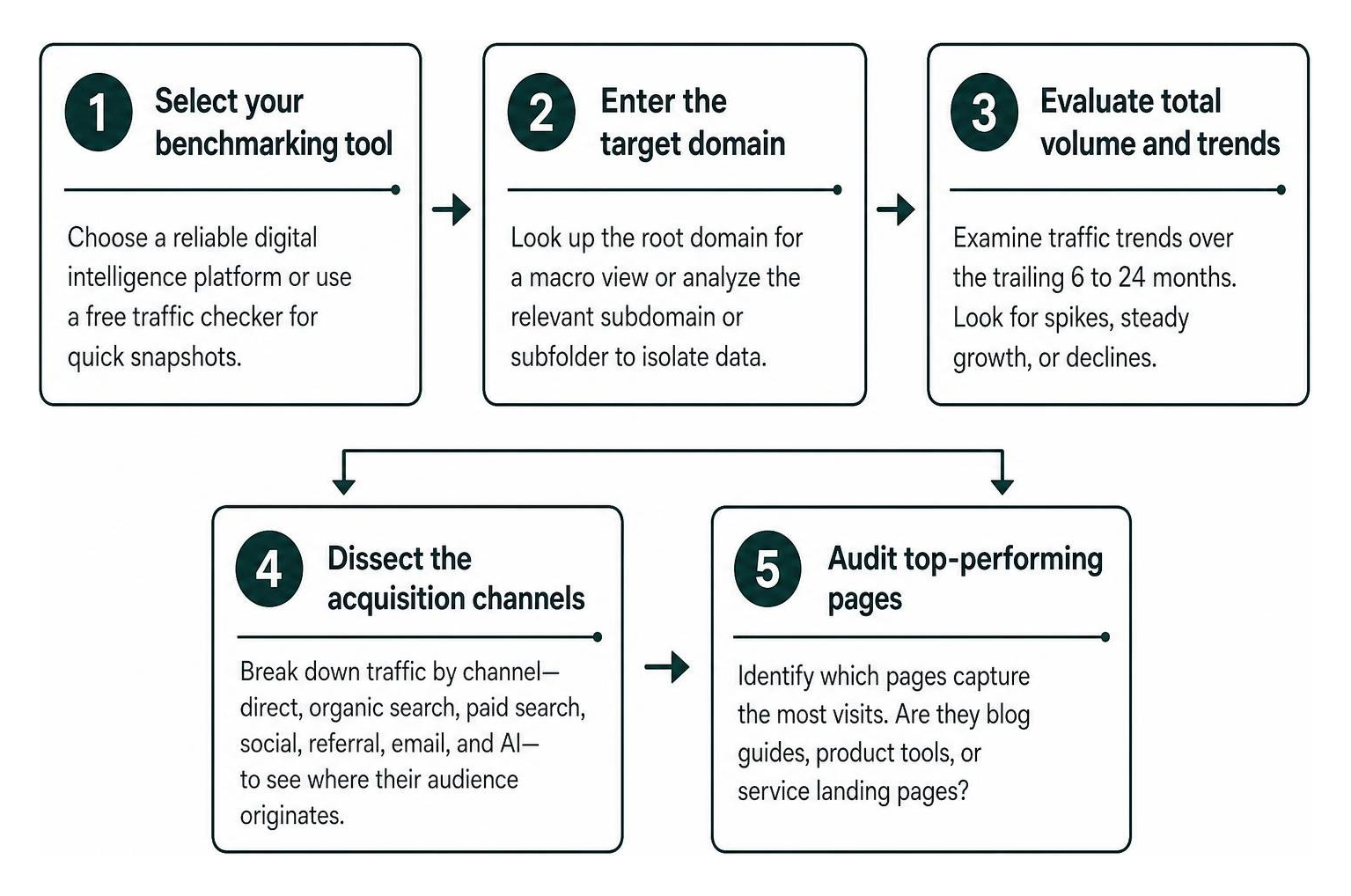
- Select your core benchmarking tool: Choose a reliable digital intelligence platform. For quick snapshots, you can run a quick check on a free SEO website traffic checker or use a free platform like the Similarweb Website Traffic Checker or Semrush Website Traffic Checker.
- Enter the target domain: Look up the root domain (e.g.,
competitor.com) for a macro view. If you compete with a specific division of a large enterprise, analyze the exact subdomain (shop.competitor.com) or subfolder (competitor.com/solutions) to isolate relevant data. - Evaluate total volume and trendlines: Examine traffic trends over the trailing 6 to 24 months. Look for sudden spikes, steady upward trajectories, or ongoing declines.
- Dissect the acquisition channels: Break down traffic into direct, organic search, paid search, social, referral, email, and AI channels to identify where their audience originates.
- Audit top-performing pages: Identify which specific URLs capture the highest percentage of total visits. Are they long-form blog guides, product calculators, or dedicated service landing pages?
- Extract keyword and referral lists: Export the top organic search queries and referring domains into a spreadsheet to identify immediate content and partnership gaps.
| Metric Category | Primary Insights Provided | Strategic Action for Your Brand |
|---|---|---|
| Traffic Volume & Trends | Overall market share, growth velocity, seasonality | Set realistic baseline KPIs and identify seasonal demand shifts |
| Traffic Sources Breakdown | Reliance on organic, paid, social, direct, or referral | Prioritize underutilized channels where competitors are weak |
| Top Pages & Subfolders | Highest-converting offerings, popular content themes | Develop stronger, more comprehensive resources on key topics |
| Audience Engagement | Bounce rate, pages per session, time on site | Optimize user experience, page layout, and conversion funnel |
| Geographic Distribution | Core regional markets and international footprint | Uncover regional demand and launch targeted local campaigns |
Core Metrics to Track When You Check Website Traffic
When evaluating competitive data, focus on engagement quality alongside sheer volume. A rival generating 500,000 visits with an 85% bounce rate and a 20-second visit duration may drive fewer qualified leads than a competitor capturing 40,000 highly engaged visitors. For a complete breakdown of every critical metric, explore our website statistics complete guide.
Key engagement signals to monitor include:
- Monthly Unique Visitors: The estimated number of distinct individual users landing on the domain within a given month.
- Total Visits: The total number of sessions, including repeat visits from the same users.
- Pages Per Session (Pages Per Visit): The average number of pages a visitor browses before leaving. A high number suggests strong site architecture, sticky content, and clear calls to action.
- Average Visit Duration: The amount of time users spend exploring the site. Extended sessions typically signal high-intent readers or software users actively engaging with the product.
- Bounce Rate: The percentage of visitors who leave after viewing only one page. High bounce rates on informational blog posts are normal, but high bounce rates on conversion-focused landing pages highlight structural friction.
Uncovering Traffic Sources and Channel Distribution
Competitors build their traffic engines across different channels. Identifying their primary acquisition source tells you what strategy fuels their business model:
- Direct Traffic: Visitors who enter the URL directly into their browser address bar or use bookmarks. High direct traffic indicates powerful brand recognition, offline marketing impact, or an existing customer portal.
- Organic Search: Unpaid visitors arriving via search engines like Google and Bing. High organic shares mean the competitor has invested heavily in technical SEO, content marketing, and backlink acquisition.
- Paid Search (SEM/PPC): Visitors generated through Google Ads or paid search placements. If paid search accounts for a large percentage of their traffic, inspect their target keywords to see which queries drive revenue.
- Referral Channels: Traffic coming from links on external blogs, directories, review platforms, or affiliate websites. These sites can become prime candidates for your own outreach and link-building campaigns.
- Social Media: Visits originating from platforms like LinkedIn, YouTube, Instagram, X, or Reddit. This highlights whether community building and social distribution are core growth levers.
- Email Campaigns: Visits tagged with email parameters, signaling an active subscriber list and consistent nurturing sequences.
Identifying Keyword Gaps and High-Converting Opportunities
Organic search remains one of the highest-ROI acquisition channels in digital marketing. When you inspect a competitor’s organic search footprint using tools like Ahrefs Website Traffic Checker or SpyFu, you can see the precise search queries driving qualified prospects to their pages.
To conduct a content and keyword gap analysis:
- Identify the top 50 pages driving traffic to your competitor.
- Extract the primary and secondary keywords those pages rank for on page one of Google.
- Cross-reference those keywords against your own domain’s rankings.
- Group missing queries into intent clusters: informational (guides, tutorials), commercial (comparisons, best-of lists), and transactional (service pages, software pricing).

Uncovering these gaps helps you create content that fills unmet needs. If three competitors rank for a high-value commercial query with outdated articles, you can craft a comprehensive, modern resource that outranks them. Aligning your content production with user intent is a reliable path toward boosting conversion rates with SEO strategies.
Advanced Methods to Check Website Traffic Across AI and Referral Channels
Digital marketing is shifting as generative AI search engines and conversational chatbots alter how users find information. In addition to traditional search engines, tools now track visits originating from platforms like ChatGPT, Google Gemini, and Perplexity.
The Similarweb Chrome extension, which maintains a 4.6 out of 5 rating across more than 3,800 reviews and serves over 1,000,000 active users, offers dedicated AI traffic detection. This feature tracks the share of domain traffic originating from AI chatbot prompts, highlighting which conversational engines mention your competitors and send downstream referral traffic.
Understanding these referral paths allows you to optimize your digital footprint for AI citation. Conversational models pull answers from high-authority niche publications, clear schema markups, and well-structured industry databases. By discovering which platforms feed citations to your rivals, you can secure placements on the same sources and capture your share of generative search traffic.
Evaluating Free Tool Limitations vs. Enterprise Intelligence
Free traffic estimation tools are great for fast surface-level audits, but they come with functional limitations. When conducting comprehensive market research, knowing when to rely on free checkers and when to deploy enterprise-grade intelligence platforms is crucial. To explore visitor tracking in depth, read our guide on how to find out exactly how many visitors any website gets each day.
Free tools generally cap daily usage. For instance, free web queries on Similarweb often limit users to three daily searches. Free tools also truncate keyword and backlink exports, showing only the top five or ten entries.
Upgrading to enterprise-tier subscriptions provides multi-year historical archives, complete keyword databases, paid search ad creative histories, geographic segmentation across hundreds of countries, and custom dashboard reporting.
Analyzing Multiple Websites Simultaneously
Auditing competitors one by one becomes tedious when analyzing an entire market sector. Multi-domain comparison workflows allow you to benchmark multiple businesses at once.
- Ahrefs Batch Analysis: The Ahrefs platform allows marketers to upload and evaluate up to 200 websites simultaneously, pulling estimated monthly search traffic, domain authority metrics, and backlink counts across 171 countries.
- Thunderbit Competitor Analysis: Serving more than 200,000 users worldwide, the Thunderbit Competitor Analysis Tool allows teams to compare up to five competitor URLs side by side, extracting public metadata, engagement stats, and structural tech stack data directly into spreadsheets without manual copying.
- Similarweb Multi-Domain Dashboards: Enables side-by-side market share visualization across 50+ countries and 200+ industry categories, tracking which brand is capturing new category search demand in real time.
Frequently Asked Questions About Website Traffic Analysis
How accurate are third-party traffic estimation tools?
Third-party traffic tools provide modeled estimates rather than direct server counts. They are most accurate for mid-sized and large websites (typically between 5,000 and 100,000 monthly visits), where panel sample sizes are robust. Use these tools to track percentage growth trends, channel mix proportions, and relative market positioning rather than viewing them as absolute numbers.
Can you see which AI chatbots drive traffic to websites?
Yes. Modern digital intelligence platforms and browser extensions track referral headers from conversational AI engines, including ChatGPT, Perplexity, Claude, and Google Gemini. These tools show the volume of traffic driven by AI engines and highlight the prompt themes that triggered the citation.
How often should you monitor website statistics?
Establish a monthly cadence for routine competitor traffic audits to catch emerging seasonal trends, content campaigns, and paid search shifts. If you operate in a fast-moving, highly competitive niche, quarterly deep-dive audits paired with automated weekly rank tracking will give you the agility needed to respond to sudden market movements.
Conclusion
Analyzing competitive traffic data transforms raw web metrics into a clear roadmap for digital growth. By identifying which acquisition channels, high-converting keywords, referral partnerships, and AI search engines drive traffic to rivals, you eliminate guesswork and invest your marketing resources where they generate the highest return.
Ready to see how the top market intelligence platforms stack up side by side? Read our in-depth review in the ultimate best free website traffic checker showdown to select the right platform for your team.