

Why a Traffic Analysis Website Matters for Growing Brands
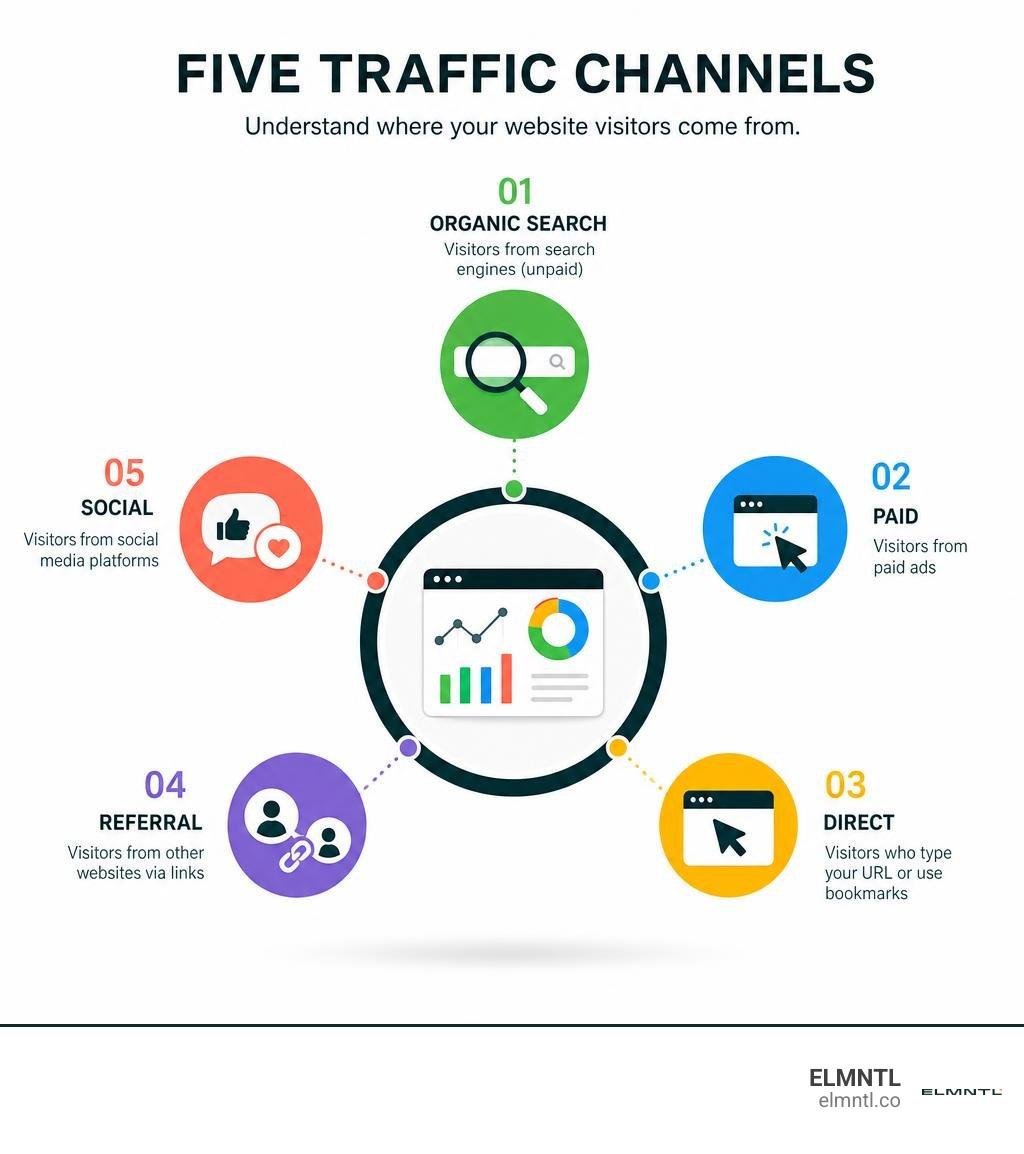
A reliable traffic analysis website helps you see where visitors come from, what they do on your site, and which marketing efforts lead to revenue. Start by tracking five channels, organic search, paid ads, direct visits, referrals, and social media. Then compare traffic volume with engagement and conversions, not visits alone.
For your own website, use first-party analytics to measure real visitor behavior. For competitors, use traffic intelligence tools to estimate their traffic trends, top channels, keywords, referring sites, and markets. Treat competitor numbers as directional estimates, then use the patterns to find stronger content ideas, SEO gaps, and wasted ad spend.
Growing brands need this visibility because traffic without context can be misleading. A campaign that brings fewer visitors but more qualified leads may be far more valuable than a high-volume channel with quick exits and no sales.
ELMNTL brings experience in digital strategy, website experiences, integrated campaigns, and performance marketing to the work of choosing and using a traffic analysis website. That perspective helps connect analytics data to the decisions that improve visibility, engagement, and conversion.
Traffic analysis website vocab to learn:
The Core Value of Web Traffic Analysis for Modern Growth
Driving digital growth without traffic analysis is like navigating a busy city with your eyes closed. You might be moving forward, but you have no idea which turns are working or when you are about to hit a dead end. Web traffic analysis gives brands complete clarity over visitor behavior, traffic acquisition channels, and conversion paths so every marketing decision is backed by hard numbers.
When you stop guessing your site statistics, you uncover the real health of your digital presence. High traffic numbers might look great in an executive meeting, but if those visitors leave within three seconds, your acquisition strategy is flawed. Analyzing metrics like retention rates, bounce rates, and session paths allows you to diagnose technical bottlenecks, refine your messaging, and double down on campaigns that actually drive revenue.
Acquisition Channels and User Behavior Breakdown
To understand how visitors reach your site, you must evaluate the five core acquisition channels:
- Organic Search: Users who find you via search engines like Google. This traffic reflects your SEO authority and content relevance.
- Direct Visits: Visitors who type your URL directly into their browser or click on untracked bookmarks. This measures brand recognition and customer loyalty.
- Referral Channels: Traffic coming from external websites, partner backlinks, or digital PR coverage.
- Paid Advertising: Clicks generated through search ads, display banners, and paid placements across networks.
- Social Traffic: Audiences arriving from platforms like LinkedIn, Instagram, X, or YouTube.
Beyond source tracking, monitoring user behavior metrics like session duration and pages per visit reveals content resonance. Exploring Matomo’s evaluation of website traffic analysis tools highlights how understanding these behavioral layers helps brands distinguish between casual skimmers and high-intent buyers.
First-Party Web Analytics vs. Third-Party Traffic Analysis Website Solutions
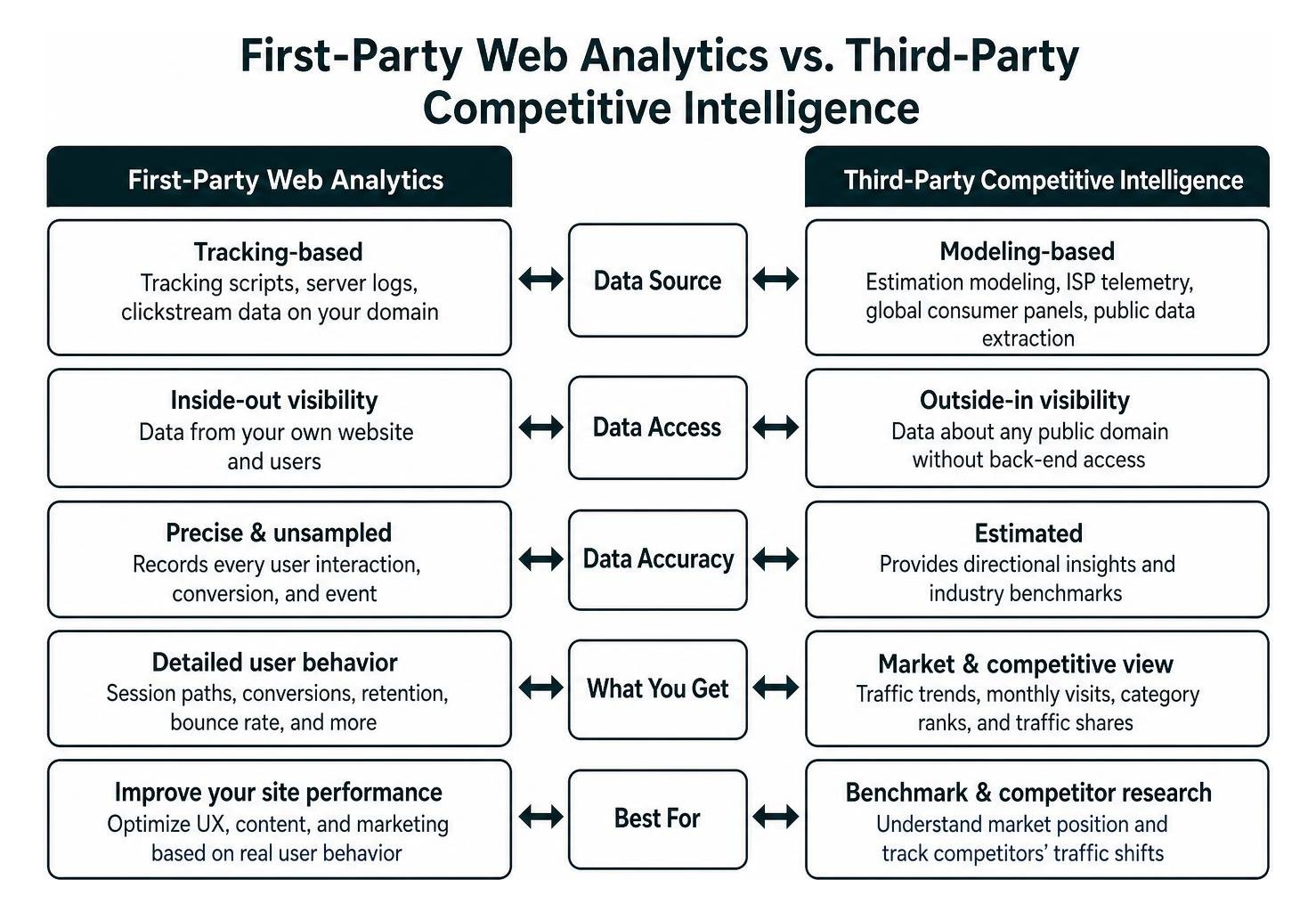
A common point of confusion is the difference between first-party analytics tools and third-party competitive intelligence platforms.
First-party analytics rely on tracking scripts, server logs, and clickstream data embedded directly on your domain. They provide precise, un-sampled records of every user interaction, cart addition, and form submission.
In contrast, third-party competitive intelligence platforms use estimation modeling, ISP telemetry, global consumer panels, and public data extraction. Platforms like Traffic.cv monthly domain intelligence provide outside-in visibility across any public domain. These platforms survey traffic shifts, showing monthly visits, category ranks, and traffic shares without needing back-end administrative access.
Essential Metrics to Evaluate Website Performance and ROI

Evaluating website performance requires moving past vanity numbers. Looking only at total visits obscures whether your visitors are unique prospects or the same team members testing pages. By tracking unique visitors alongside exit rates and session depth, you build a foundation for understanding your true marketing ROI and calculating accurate customer acquisition costs.
Engagement and Conversion Benchmarks
Understanding engagement means tracking both micro conversions (newsletter signups, video plays, whitepaper downloads) and macro conversions (demo bookings, direct checkout purchases).
| Metric Category | Key Metric | Benchmark Target | Strategic Purpose |
|---|---|---|---|
| Volume | Unique Visitors | Upward MoM Trend | Measures brand reach and audience expansion |
| Engagement | Average Session Duration | 2 to 4 Minutes | Assesses content relevance and user interest |
| Navigation | Pages per Visit | 2.5+ Pages | Evaluates internal linking and user exploration |
| Retention | Bounce Rate | 30% to 50% | Identifies landing page friction or targeting mismatch |
| Outcome | Conversion Rate | 2% to 5% (Industry dependent) | Quantifies direct commercial efficiency |
By measuring marketing success through analytics, you can identify which pages lose attention and adjust user flows before launching high-budget campaigns.
Estimating Competitor Footprints and Market Share
Third-party traffic tools reveal how your competitors capture market share across different regions and marketing channels. By analyzing audience overlap and competitive search volume, you can identify which channels your rivals rely on most.
Tools like Website Traffic Checker – Free Analytics For Any Website | Similarweb aggregate data from multiple sources to show category rankings and regional traffic share. Similarly, finding out how many visitors any website gets daily gives you the benchmarks needed to spot seasonal demand patterns, analyze product launches, and capture under-served market segments.
Top Platforms: Choosing the Best Traffic Analysis Website for Scaling
Selecting the right platform depends on whether you need internal product telemetry, external competitive audits, or a blend of both. Using free website traffic checker tools to estimate visitor counts is a great starting point for high-level research.
| Tool / Platform | Primary Focus | Key Advantage | Best Use Case |
|---|---|---|---|
| Similarweb | Competitive Intelligence | Robust panel data; strong accuracy for 5K-100K monthly users | Market share benchmarking and channel breakdown |
| Ahrefs Traffic Checker | SEO & Search Visibility | Proprietary index with batch audits for up to 200 sites | Organic keyword research and paid ad spying |
| Traffic Lens | Real-Time Domain Analytics | Real-time tracking across 200M+ domains with zero signup | Instant domain lookups and rapid competitive scans |
| TrackTraffic | First-Party Analytics | Cookieless, async script (<3KB), privacy-friendly | Lightweight first-party conversion and ROAS tracking |
| Traffic.cv | Public Domain Monitoring | Monthly survey snapshots, keyword trails, revenue signals | Trend tracking and public leaderboards |
| TrafficTrail | Live Journey Mapping | AI alerts for anomalies and 98ms real-time latency | Visualizing visitor drop-offs and live bot detection |
Competitive Intelligence and Estimation Engines
When analyzing external market players, tools that combine multi-source modeling with search engine indexing offer deep strategic value. For example, Website Traffic Checker: Estimate Any Site’s Traffic allows marketers to analyze organic search estimates across 171 countries, uncover competitor ad spend, and run batch audits on up to 200 domains simultaneously.
For instant, lightweight domain checks, Traffic Lens real-time domain analytics monitors visit counts, bounce rates, and traffic quality scores across more than 200 million domains. For tracking live network performance and anomalies at the infrastructure level, solutions like Tsharky — Network Traffic Analyzer | PCAP Deep Inspection & Anomaly Detection provide deep packet inspection and protocol analysis.
Privacy-First Analytics and Real-Time Tracking
Modern tracking requires balancing granular data with strict global compliance standards like GDPR and CCPA. Platforms like TrackTraffic — Analytics Dashboard solve this by offering cookieless tracking scripts under 3KB that run asynchronously without hurting Core Web Vitals. This approach gives growing brands accurate visitor attribution and return on ad spend (ROAS) data without requiring intrusive cookie consent banners.
For SaaS applications, platforms like TrafficTrail — Traffic Analytics SaaS offer AI-driven anomaly alerts and visual journey mapping with low latency, helping teams catch technical drop-offs in real time. Organizations managing specialized local infrastructure can also leverage survey platforms like Global Traffic Analytics: Traffic Survey Company to process broader market trends.
Key Criteria to Evaluate Any Traffic Analysis Website
When selecting an analytics platform, focus on these six functional criteria:
- Data Freshness: How quickly does the platform update its reporting dashboards?
- Domain Coverage: Does the platform track niche, mid-market, and enterprise-scale websites accurately?
- Historical Depth: Can you review multi-year seasonal trends and historical shifts?
- Reporting Accuracy: Are estimation models backed by diverse telemetry, panels, and public indexes?
- Integration Capability: Does the tool integrate smoothly with your tag managers, CRM systems, and reporting stacks?
- Cost Efficiency: Does the pricing scale predictably as your tracked domains and visitor volume grow?
Turning Traffic Insights into Actionable Marketing Strategies

Collecting data is only the first step. Turning traffic data into business growth requires translating charts into clear marketing actions. By understanding critical website statistics, you can align your content production, ad budgets, and design updates with proven visitor demand.
Uncovering Content Gaps and SEO Opportunities
One of the fastest ways to grow organic traffic is by finding keywords your competitors rank for that you have missed.
Using domain intelligence tools, you can analyze search intent, examine top-performing URLs in your niche, and map out content gaps. When you identify competitor pages that attract steady search volume despite having thin content, you can build more comprehensive, helpful resources that win search visibility and capture high-intent traffic.
Conversion Rate Optimization and Journey Mapping
Traffic volume means very little if your conversion funnel has high drop-off rates. Visitor journey mapping allows you to pinpoint the exact pages where users bounce.
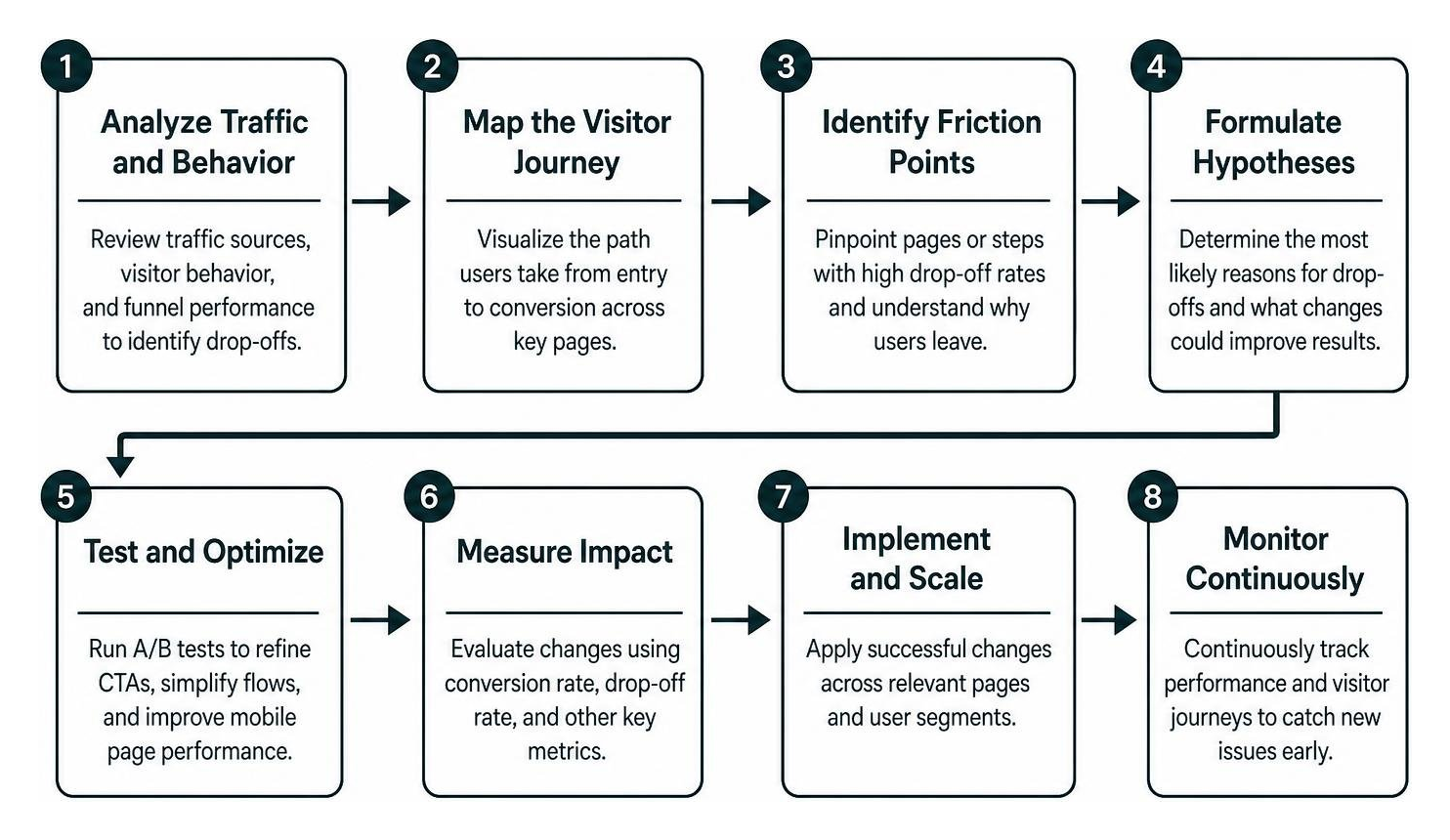
Once you spot friction points, apply structured A/B testing techniques for conversion rate optimization to refine your calls to action, simplify checkout flows, and improve mobile page performance. Small improvements to your conversion path often deliver a much higher ROI than simply buying more traffic.
Frequently Asked Questions About Website Traffic Analysis
How accurate are third-party traffic estimates?
Third-party traffic tools use statistical modeling, ISP data, consumer panels, and public search scraping rather than direct access to a website’s private server. As a result, they provide directional estimates rather than exact numbers. Studies show these tools are most accurate when analyzing medium-to-large websites (such as those receiving between 5,000 and 100,000 monthly visits). While absolute numbers may vary from internal analytics, the relative rankings, channel splits, and growth trends remain dependable indicators for competitor benchmarking.
Can I analyze competitor traffic without installing code?
Yes. Competitive intelligence platforms analyze public web footprints, including search engine rankings, backlink profiles, clickstream panels, and domain telemetry. You simply enter a competitor’s domain into the search bar of a traffic checker to review their estimated visitor volume, top traffic channels, referring sites, and primary search keywords without needing back-end access or tracking scripts.
How do modern analytics platforms handle GDPR and privacy compliance?
Modern first-party analytics platforms use privacy-first tracking methods that comply with GDPR, CCPA, and PECR regulations. Instead of saving persistent tracking cookies on user devices, these tools use anonymized IP hashing, session-only identifiers, and aggregated telemetry. These lightweight scripts operate without collecting personally identifiable information (PII), allowing businesses to monitor visitor behavior accurately without showing complex cookie consent banners.
Conclusion
Sustained digital growth requires clear, full-funnel visibility. Relying on guesswork leaves your marketing vulnerable to shifting algorithms and wasted ad spend. By combining privacy-first analytics for your own domain with third-party competitive intelligence tools, you gain the insights needed to make data-backed decisions.
At ELMNTL, we help brands connect their analytics data directly to performance marketing, conversion design, and integrated digital strategies that accelerate growth. To see how today’s leading platforms compare, explore our ultimate website traffic checker showdown and choose the right tools to scale your business with confidence.