

How to Choose Fast Website Development Services
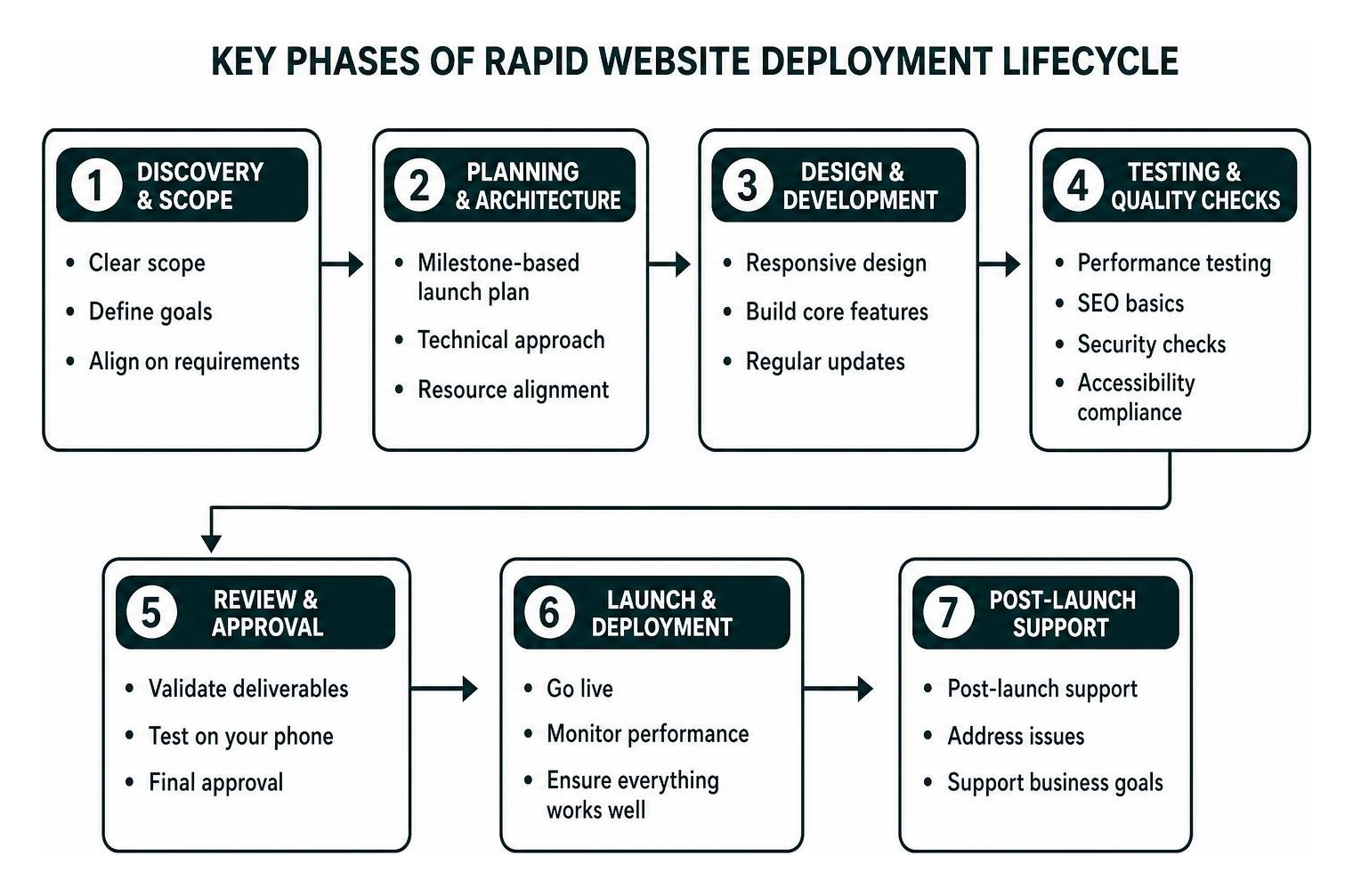
Choose fast website development services by asking each provider for a clear scope, a milestone-based launch plan, and examples of live sites you can test on your phone. Confirm that the plan includes responsive design, performance testing, SEO basics, security checks, and post-launch support. A short deadline is useful only if the finished site works well and supports your business goals.
A strong partner will also explain who makes decisions, how often you will get updates, and what happens if the scope changes. Those details help you move quickly without leaving important work until after launch.
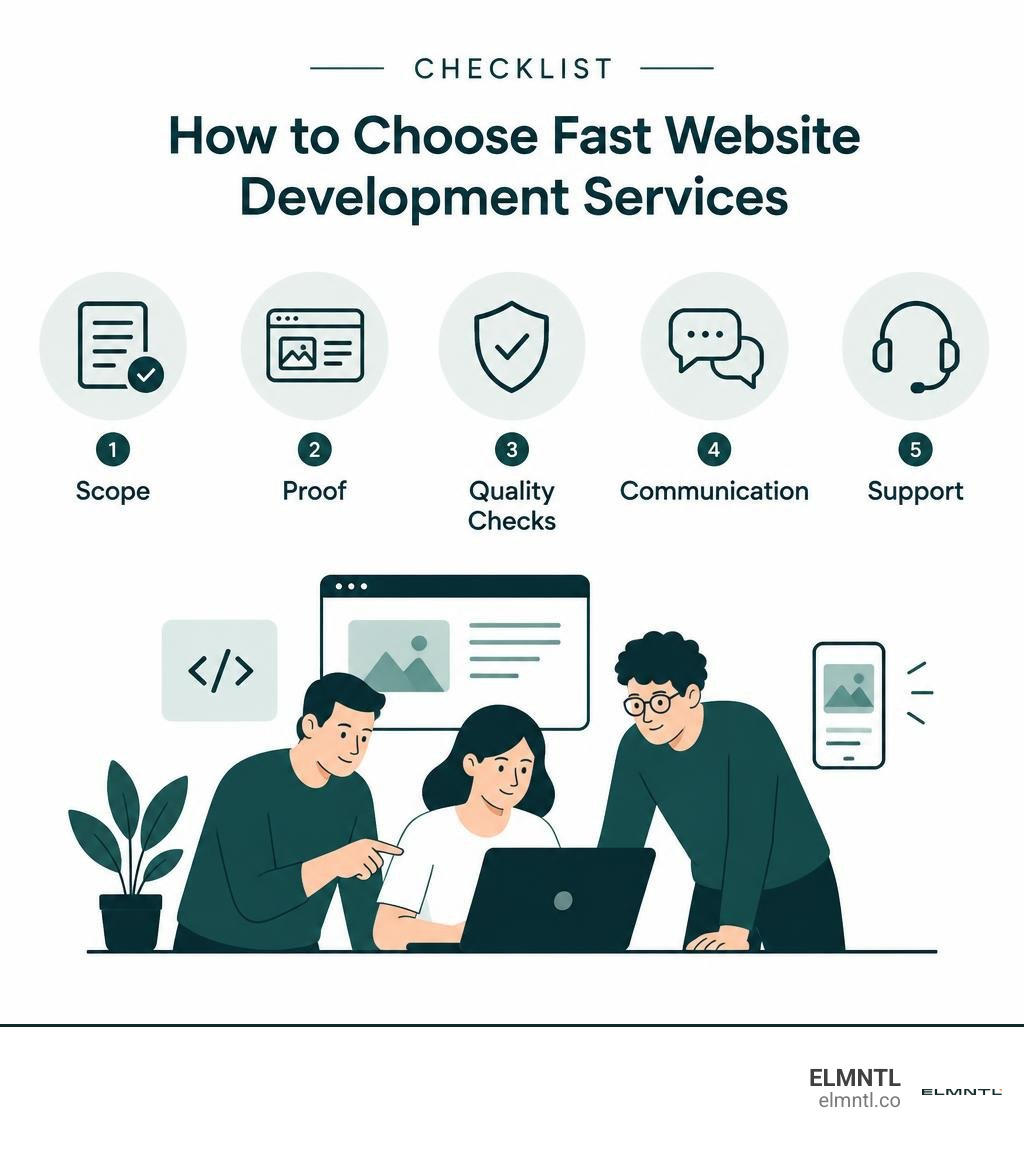
Must-know fast website development services terms:
Key Evaluation Criteria for Fast Website Development Services
Selecting the right partner requires separating true engineering efficiency from rushed shortcuts. When your business needs to move quickly, evaluating vendors based on structured milestones and velocity metrics is essential. Reviewing the business case for professional custom web design services shows that professional development teams protect technical integrity while meeting aggressive commercial deadlines.
Pricing transparency and milestone governance should top your qualification checklist. Development agencies typically charge hourly rates ranging between $25 and $99 depending on team composition and geographic distribution, with standard business builds ranging from $10,000 to over $200,000 for enterprise platforms. Fast-track projects require clear phase gates so that budget allocations match completed deliverables. Federal standards, such as the checklist of requirements for federal websites and digital services from Digital.gov, highlight that structural compliance, security, and usability cannot be compromised for speed.
Technical Stack and Modern Frameworks
The underlying technology stack determines how quickly an agency can build and deploy your platform. Modern rapid engineering relies on component-driven architectures, Jamstack approaches, and headless content management systems. Frameworks like React, Next.js, and Node.js allow developers to reuse modular UI blocks, which significantly cuts build times while delivering superior page speed.
A comprehensive breakdown of 20 website development services illustrates how modern development separates front-end visual presentation from back-end logic through APIs. This separation lets engineering teams build the user interface and back-end database models simultaneously rather than sequentially, reducing your overall time to market.
Project Management and Communication Protocols
Speed without structured communication leads to confusion and rework. Elite development teams run on agile sprint workflows managed through platforms like Jira, paired with daily asynchronous communication via Slack. This level of organization gives you complete visibility into progress at every stage.
Proven agencies maintain high satisfaction ratings, often achieving near-perfect client feedback, because they emphasize transparent project governance. Clear milestones prevent misalignment, reduce feedback bottlenecks, and keep the launch timeline on schedule.
Portfolio Verification and Case Studies
Never evaluate a development partner solely on static design mockups. Real technical speed is proven in production. Inspect live websites from an agency’s portfolio directly on your mobile device to test real-world Core Web Vitals, touch interactions, and rendering speed.
Third-party directories provide objective performance data. Reviewing verified client ratings and industry directory rankings on Clutch helps confirm an agency’s track record for delivering projects on time, maintaining technical stability, and staying within budget.
Essential Service Offerings for Rapid Digital Turnaround
To achieve an accelerated deployment without sacrificing quality, your agency must provide integrated, full-stack capabilities under one roof. Juggling separate vendors for design, coding, and infrastructure creates handoff friction that delays your launch.

Essential Fast Website Development Services for High-Growth Brands
High-growth organizations require a multi-disciplinary team capable of delivering custom front-end styling, robust back-end architecture, and seamless API integrations. Knowing the 10 things to prepare before working with a web design agency helps ensure your branding assets, technical requirements, and functional specifications are ready on day one.
Comprehensive development services combine responsive UI design with dynamic microinteractions and third-party data connections. When front-end and back-end developers work in tandem, features like customer portals, booking engines, and CRM integrations can be built and tested within compressed sprint cycles.
Custom CMS and Backend Integration
An effective website must empower your internal team to publish and update content easily after launch. Accelerated development models often leverage modular, headless CMS platforms that offer dynamic routing and flexible database structures.
Our agency guide to custom CMS development outlines how customized back-end dashboards streamline content workflows without bloating your codebase. Tailored CMS architectures eliminate unneeded plugins, reducing security risks and keeping server response times fast.
Performance Optimization and Mobile Responsiveness
A fast development cycle must result in a fast-loading website. Mobile responsiveness is mandatory, as digital traffic continues to skew heavily toward handheld devices. Code minification, asset compression, content delivery network (CDN) routing, and server-side caching must be built into the deployment pipeline from the start.

Following the complete guide to website performance ensures that your site achieves top Core Web Vitals scores. Excellent load speed improves conversion rates, boosts organic search visibility, and provides a polished user experience across every device.
Local Support vs Remote Teams in Rapid Web Builds
When hiring for fast turnaround, businesses often weigh the benefits of local agencies against distributed engineering teams. Both models offer distinct operational advantages depending on your internal workflows and strategic needs.
| Factor | Local Agency Model | Distributed Remote Engineering | Hybrid Partner Model |
|---|---|---|---|
| Communication | In-person strategy sessions and shared time zones | Asynchronous updates and digital messaging | Strategic local management with global technical execution |
| Development Velocity | Standard business hours | Continuous round-the-clock development handoffs | Rapid sprint cycles with coordinated review windows |
| Market Alignment | Deep regional and cultural context | Broad global perspectives | Localized strategy combined with scalable development |
| Cost Efficiency | Higher local overhead costs | Optimized engineering rates | Balanced, high-value investment structure |
Benefits of Local Agency Proximity
Local agencies excel at hands-on collaboration. In-person workshops, real-time whiteboarding sessions, and shared working hours make it easier to refine complex brand positioning and align key stakeholders. When executive consensus is critical to project velocity, local proximity can eliminate communication delays.
Advantages of Agile Distributed Engineering
Distributed development teams provide exceptional production speed through around-the-clock development cycles. A team operating across multiple time zones can design during your business day and deploy code overnight, effectively doubling your project’s momentum while drawing from top-tier global technical talent.
Common Pitfalls and Red Flags When Hiring for Speed
Rushing a web build can expose your brand to significant risks if your vendor cuts corners. Unrealistically cheap proposals are often the biggest red flag. Bargain-rate agencies frequently rely on bloated pre-made templates, outsourced sub-tier labor, and fragile codebases that fail under real traffic.
Carefully review vendor contracts to confirm you retain 100 percent ownership of your custom code, database assets, and digital design files. Discovering how to choose the right managed web services for your business ensures you have ongoing maintenance, security patching, and hosting support long after the initial launch.
Vetting Fast Website Development Services for Enterprise Scalability
A rapidly built site must be engineered to grow alongside your business. Taking shortcuts on server architecture or database design leads to technical debt that requires expensive rebuilds later.
Learning how to build a scalable enterprise website helps you validate that candidate agencies use modular component libraries and clean data structures capable of handling traffic spikes without performance drops.
Hidden Costs and Ambiguous Scope Creep
Vague statements of work are a primary cause of budget overruns and missed launch dates. Ensure your project scope defines exact revision rounds, change order protocols, and post-launch bug remediation windows.
Using the ultimate SEO website redesign checklist will help protect your technical performance and organic rankings throughout the development process.
Before signing off on a rapid build, verify that your development team completes these essential security audit milestones:
- Implementation of modern SSL/TLS encryption certificates
- Role-based administrative access controls and multi-factor authentication
- Automated database backup and disaster recovery configurations
- Sanitized input fields to prevent SQL injection and cross-site scripting (XSS)
- Web Content Accessibility Guidelines (WCAG) compliance validation
Frequently Asked Questions About Rapid Web Development
How quickly can a corporate website be built without sacrificing quality?
A custom, high-performance corporate website can typically be deployed within 4 to 8 weeks when using agile sprint methodologies and pre-established design systems. This timeline requires disciplined scope prioritization, prompt stakeholder reviews, and automated quality assurance pipelines.
What modern technologies accelerate web development timelines?
Development speed is accelerated by headless CMS platforms, reusable UI component libraries, serverless hosting environments, and pre-built API connectors. Modern build tools eliminate manual server setup and streamline asset compilation, allowing developers to focus on custom features and user experience.
How do fast development builds handle post-launch security and SEO?
Quality development teams integrate technical SEO foundations and security protocols directly into their sprint workflows. Clean URL routing, canonical tags, automated XML sitemaps, structured data markup, and baseline security configurations are established before any content goes live.
Conclusion
Securing fast website development services is about engineering discipline, transparent communication, and modern technical architecture. By prioritizing agile milestones, verifying live portfolio performance, and ensuring full-stack capabilities, your business can launch quickly without compromising on scalability, security, or user experience.
At ELMNTL, we bring over 15 years of industry experience and more than 30 creative awards to every digital project. We combine global technical capabilities with localized digital strategies to build digital experiences that drive measurable business growth. Explore our integrated marketing and digital strategy solutions to see how we can accelerate your digital roadmap and deliver a high-performing website built for long-term success.