
What a UI UX design consultancy does for your business
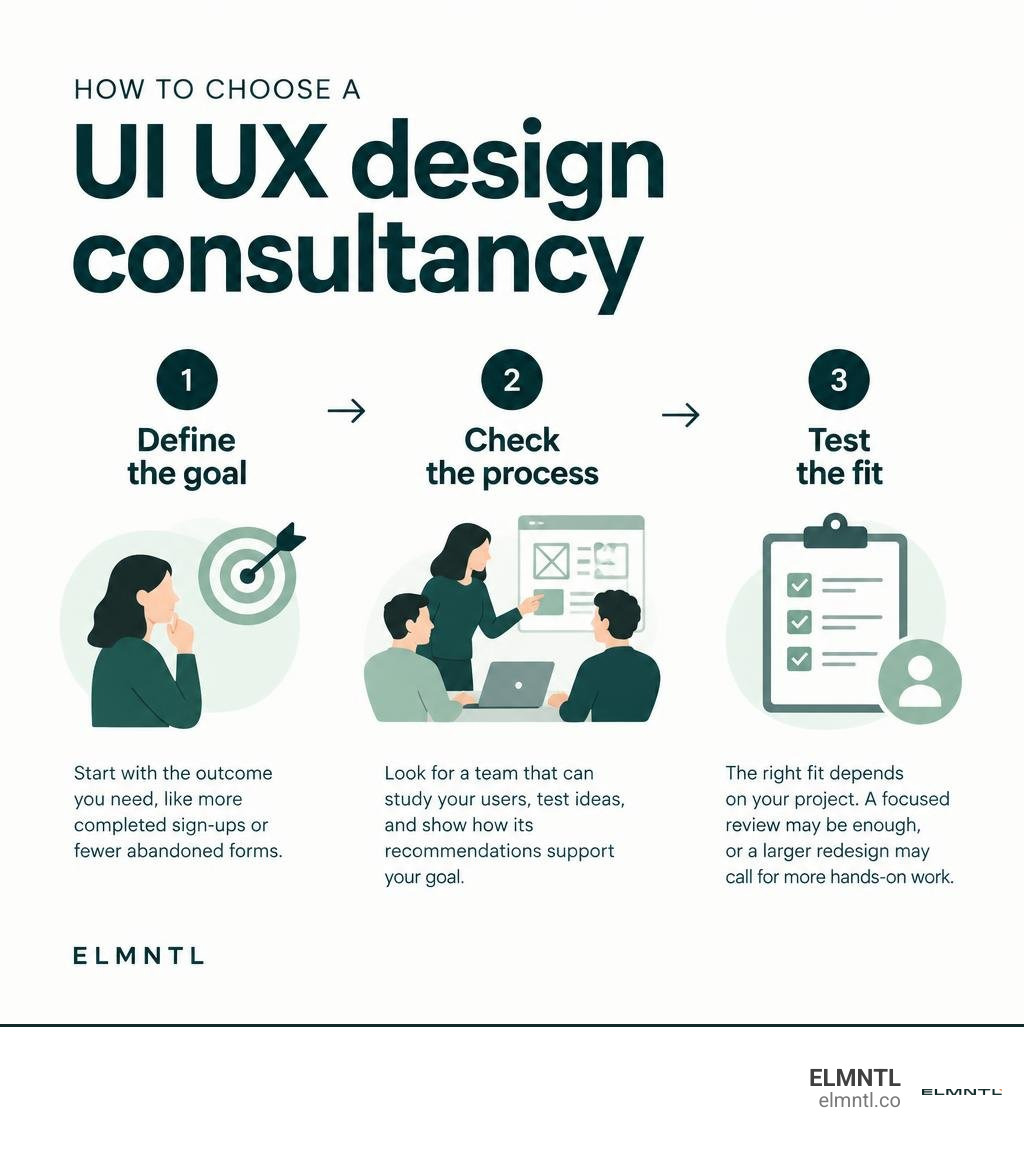
A UI UX design consultancy helps you find and fix problems that make a website or digital product hard to use. To hire the right partner, start with the outcome you need, such as more completed sign-ups or fewer abandoned forms. Then look for a team that can study your users, test ideas, and show how its recommendations will support that goal.
The right fit depends on your project. A focused review may be enough to identify what needs fixing. A larger redesign may call for research, prototypes, testing, and close work with developers.
What a UI UX design consultancy actually does
What a UI UX design consultancy does beyond designing screens
Many people assume a consultancy simply makes products look better. In practice, the visual layer comes late. A good partner starts by defining the problem: who struggles, where, and what it costs you. From there the work usually covers:
- Product strategy and problem definition, so the team agrees on goals and success metrics.
- User research, such as interviews, analytics review, and observation.
- UX audits that review a live product against usability principles.
- Wireframes and interactive prototypes that let real users try a flow before any code exists.
- Usability testing, where people attempt set tasks and the design is revised from what you learn.
- Visual design and design systems, meaning reusable components and design tokens that keep the interface consistent as it grows.
- Developer handoff, with annotated specs and a walkthrough so engineers build what was designed.
Most reputable teams follow the industry-standard UX design process, but the real difference is how they adapt it to you. Ask whether each step ends with something usable, even if you stop there.
How consultancy differs from UX research and UX design
These terms overlap, so it helps to separate them.
- UX consulting is advisory. A consultant reviews a product and delivers a written audit, prioritized recommendations, or a roadmap. It usually ends at the report, and your team or another partner ships the fixes.
- UX research collects new evidence through interviews, surveys, and usability tests with your own users.
- UX design produces the shipped interface: flows, screens, prototypes, and specifications.
Consulting works mostly from evidence that already exists, such as analytics, session recordings, support tickets, past research, and expert evaluation. Research creates fresh evidence. Design turns decisions into something people use. A full-service consultancy often combines all three, but you should know which one you are buying.
A strong audit finding is specific. It names the screen, the problem, the evidence, the principle broken, a severity rating from 0 to 4, the suggested fix, and the effort involved. For example: filters reset after each invoice view, severity 3, small fix, next sprint. Findings written this way are sprint-ready, so your developers can act on them straight away.
The UX elements that shape product outcomes
Five elements decide whether a product works:
- Usability. Can people finish tasks without confusion? This covers navigation, consistency, error prevention, clear feedback, and efficiency for repeat users.
- User research. Understanding real needs through methods like interviews, surveys, card sorting, tree testing, and journey mapping. The UK government’s user research guidance is a solid public reference.
- Visual design. Hierarchy, color, and typography that make the interface clear at a glance.
- Information architecture. Sitemaps, navigation, and labels that help people find things.
- Interaction design. How the product behaves, including copy, graphical elements, context, timing, and responses to user actions.
Accessibility runs through all five. Following WCAG 2.2 accessibility guidance widens your audience and lowers legal risk. If you want a primer on the fundamentals, our guide to UI/UX basics covers them in plain language.
When hiring a consultancy makes sense
Outside help pays off when you need an answer before committing budget. Typical triggers include:
- Low conversion or high drop-off, and nobody agrees why.
- Rising churn or support calls about the same screens.
- A stalled redesign that needs restarting in testable steps.
- Complex workflows, such as admin consoles or multi-role platforms.
- A new product that needs discovery before building.
- Specialist research needs your team lacks, or limited internal capacity.
If you suspect your website is leaking conversions, a practical guide to website UX audits shows what a review should uncover. A good consultancy will also tell you when consulting is the wrong first step, for instance when you need new user data or finished screens instead.
How to choose the right design partner and engagement model
Which type of UI/UX design partner fits your project
Each model suits different situations. Match the model to your scope and how long you need support.
| Partner model | Scope | Continuity | Flexibility | Best-fit project |
|---|---|---|---|---|
| Full-service agency | Strategy, design, and often development | Project-based, can extend | Moderate | Website or product builds needing several disciplines |
| Specialist studio | Narrow focus, such as interface design or design systems | Project-based | High within its niche | Fast interface work or design system builds |
| UX consultancy | Diagnosis, audits, strategy, advisory | Short, time-boxed | High | Fixing a defined problem or deciding what to build |
| Embedded team | Dedicated designers and researchers inside your roadmap | Strong, long-term | Moderate | Evolving B2B or SaaS products |
| In-house team | Whatever you hire for | Strongest | Low, slow to scale | Mature products with steady design needs |
| Freelancer | Single skill or small task | Variable | High | Small, well-defined pieces of work |
A consultancy tends to start from your metric and problem, while an agency often works from a brief and a list of outputs. In-house designers know your product best but take time to hire and may lack a specialism. Many companies combine in-house designers with an external team that adds research or interface capacity.
How to choose a UI UX design consultancy for your project
Judge candidates on five things: process, portfolio, services, proposal, and reviews.
- Process. Look for kickoff workshops, iterative sprints, and alternatives presented rather than a single answer. The main differentiator is how much they value your input, not whether they use personas and wireframes.
- Portfolio. A pretty portfolio is not enough. Look for relevant case studies in your industry, with measurable results such as engagement, adoption, and retention.
- Services. Research and testing in the service list signal a data-driven mindset. Work without research is a warning sign.
- Proposal. It should be custom-made, transparent, and flexible. Generic proposals suggest a poor fit.
- Reviews. Check that they come from real customers on verified platforms, and look for comments on promises delivered, quality, schedule, and how conflicts were handled.
Also check team seniority, research capability, accessibility practice, and how design hands over to engineering. If any of these terms feel unfamiliar, start with our guide to UI/UX design basics.
How to compare local and global agency shortlists
Searching for providers in a city like Washington, D.C. is a reasonable starting point, but the best fit depends on your needs rather than a postcode. Start with the experience you need, whether research, UX, UI, or usability testing, then check that the team has worked in your sector. Someone building B2B software benefits from B2B product experience, while a consumer app calls for consumer product experience.
Remote delivery works well. Workshops, interviews, usability tests, and reviews all run on video, with prototypes shared in a common workspace. What matters is agreed meeting rhythm and enough time-zone overlap for quick feedback. Regional pricing also differs, with providers in the UK and North America generally charging slightly more than those in Central and Eastern Europe. Rankings and lists are useful for building a shortlist, but evidence should decide: case studies, client lists, and a conversation with the people who would actually do the work.
What to ask a UI UX design consultancy before signing
Use your calls to test depth, not polish.
- What design process do you use? Good answers are tailored to you, and you will sense whether they know the subject.
- Do you have dedicated researchers? Researchers bring fresh insight weekly, whereas designers rarely have time for it. Ask whether you can join user tests and interviews.
- Can I keep the same team on an ongoing basis? Products keep evolving, so continuity matters.
- Will the designers work full time on my product? Designers split across several projects often have unclear priorities.
- How can I support your team’s daily work? Never leave an agency completely alone. Involvement throughout is essential.
Add a few practical questions. Who does the work, and how will I see progress? How do you test with users? What happens at handoff to engineering? Who owns the deliverables, and will intellectual property be assigned to us in the contract? What security practices do you follow, and what post-launch support is available?
How to write an effective UX agency RFP
Many clients struggle to describe their challenges, so templates are common. A strong RFP is specific. Include:
- The business challenge and the users affected.
- Stakeholders and who decides.
- Current analytics, existing research, and assets or inspiration.
- Technical constraints.
- Scope and expected deliverables.
- Timeline and a budget range. Sharing a range helps agencies propose realistic options.
- Evaluation criteria, so you can compare responses fairly.
- Submission instructions and deadlines.
It helps to understand the UX design process for modern teams before you write, so your timeline and deliverables match how the work really unfolds.
Common hiring pitfalls and how to avoid them

- Choosing on portfolio alone. Check fit, process, and results.
- Vague scope. One fixed-price project estimated at three weeks stretched to four months of near full-time work after repeated scope changes. Define scope and milestones clearly.
- Generic proposals. Ask what in the proposal is specific to you.
- Research-free design. Untested assumptions become expensive rework.
- Unrealistic timelines. Research through usability testing takes real time.
- Unverified reviews. Confirm them on independent platforms.
- Unclear ownership. Settle who owns files, systems, and decisions.
- Missing accessibility requirements. State your WCAG target upfront.
- Weak engineering collaboration. Involve developers early, not at handoff.
What UI/UX design consultancy services cost and how to measure their value
Common pricing models and 2026 cost ranges
Agencies generally use three models. Time-based pricing bills hourly or daily and suits ongoing work. Fixed-price suits a clearly defined scope. Retainers or value-based agreements suit embedded teams and long-term partnerships.
| Pricing model | Typical range in 2026 | Suitable when |
|---|---|---|
| Time-based | US smaller and mid-size cities $50 to $150/hr; major hubs $75 to $200/hr; premium consultancies $250 to $500+/hr; Eastern Europe about €45 to €60/hr; Western and Northern Europe about €70 to €150/hr | Scope will evolve, or you want ongoing support |
| Fixed-price | US: $10k to $30k small builds, $30k to $80k mid-tier, $80k to $250k+ enterprise. Europe: €8k to €20k for a website or MVP, €20k to €60k for a mid-sized SaaS platform, €60k to €200k+ for enterprise redesigns | Requirements are clear and stable |
| Retainer or value-based | From roughly €500 to €1,000 per month for small-scale support, rising with team size | You need continuous improvement or an embedded team |
Some specialist UX consulting engagements start around $25,000, which gives a useful sense of the floor for senior-led audit work.
What changes the project estimate and timeline
Price follows scope. The main drivers are the number of user roles, screen count, research depth, integrations, compliance needs, design-system work, usability testing rounds, and how available your stakeholders are. A focused UX audit typically takes two to four weeks from kickoff to readout, reviewing roughly 15 to 40 screens. Several products or an added accessibility audit can stretch that to six weeks. Scope changes are the biggest source of overruns, so agree how changes will be priced. A short discovery phase or audit first is a smart way to get findings and a firm estimate before committing further.
How to connect UX work to business outcomes and ROI
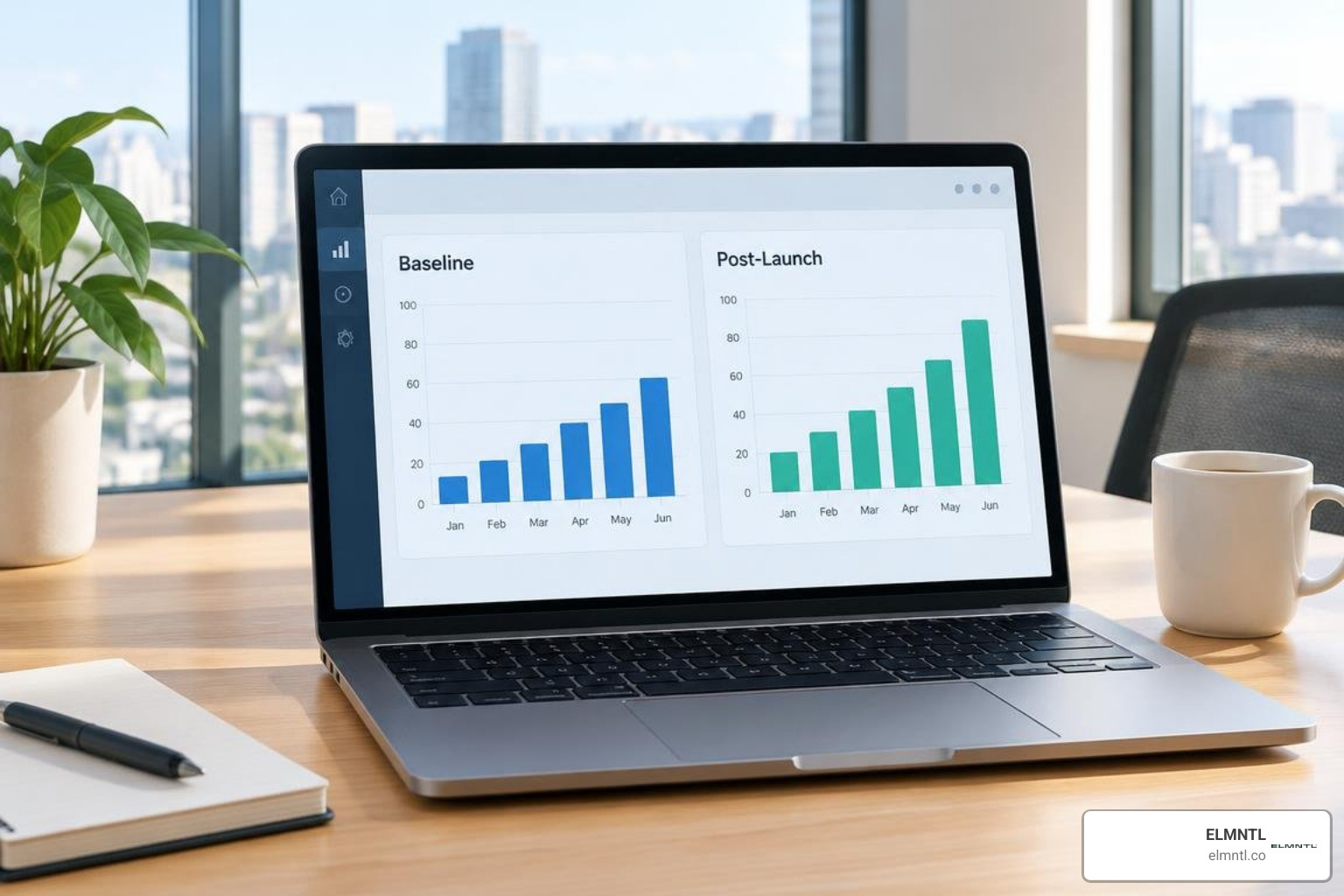
Follow four steps: define baseline business metrics, benchmark the current experience, measure the change after improvements, and translate that change into revenue gained or cost saved.
Useful metrics include:
- Conversion rate, activation, and adoption.
- Retention and churn.
- Task completion time.
- Support volume.
- Customer satisfaction and NPS.
For example, if a redesign lifts demo requests from 3% to 6% of visitors, traffic stays the same, and you know your lead value, you can calculate the revenue lift in plain terms. Research ROI works the same way: compare the cost of research with the rework, support, and lost sales it prevents. Our UX design recommendations for product teams show how to turn findings into prioritized actions.
What measurable outcomes can look like
Published results give a sense of what is possible. A real estate marketplace that added a customizable notification system saw saved-search subscriptions rise 116%, email-to-reply conversion grow 21%, and logged-in users increase 14%. An inspection platform that replaced paper checklists reported 80% fewer errors and follow-ups moving from days to minutes, with 75% faster follow-ups. Other teams track reduced support calls or fewer workflow errors. These are client-reported figures, so treat them as examples of what to measure rather than guaranteed results.
Frequently asked questions about UI/UX design consultancies
How long does a UI/UX design consultancy project take?
It follows the size of the problem. A focused audit takes two to four weeks. Discovery and research studies add time depending on how many user groups and flows you cover. Prototype testing and handoff come after, and delivery depends on your engineering schedule. Expect a firm timeline only after discovery, once scope is known.
Should I hire a consultancy, agency, or embedded team?
Choose a consultancy for a defined problem and a short engagement with specialist expertise. Choose an agency when you need design and build capability together. Choose an embedded team when you have an ongoing roadmap and want continuity. If you already have designers but lack capacity or research skills, extending your team often works best.
How can I tell whether a consultancy’s work produced business value?
Compare against the baseline you set before work began. Use product analytics, user feedback, and support data over a fixed measurement period, then convert changes in conversion, retention, or support volume into revenue impact or cost reduction.
Conclusion
The best UI UX design consultancy starts with your goals, proposes a clear scope, involves you throughout, and proves its value with measurable outcomes. Define what success looks like, shortlist partners on evidence, and ask hard questions before signing. At ELMNTL, we bring over 15 years of experience in web design, strategy, and branding to help teams turn user insight into results. To prepare your own toolkit, explore our UI and UX design software guide.