

Why Customized Solutions Deliver Faster, More Relevant Results
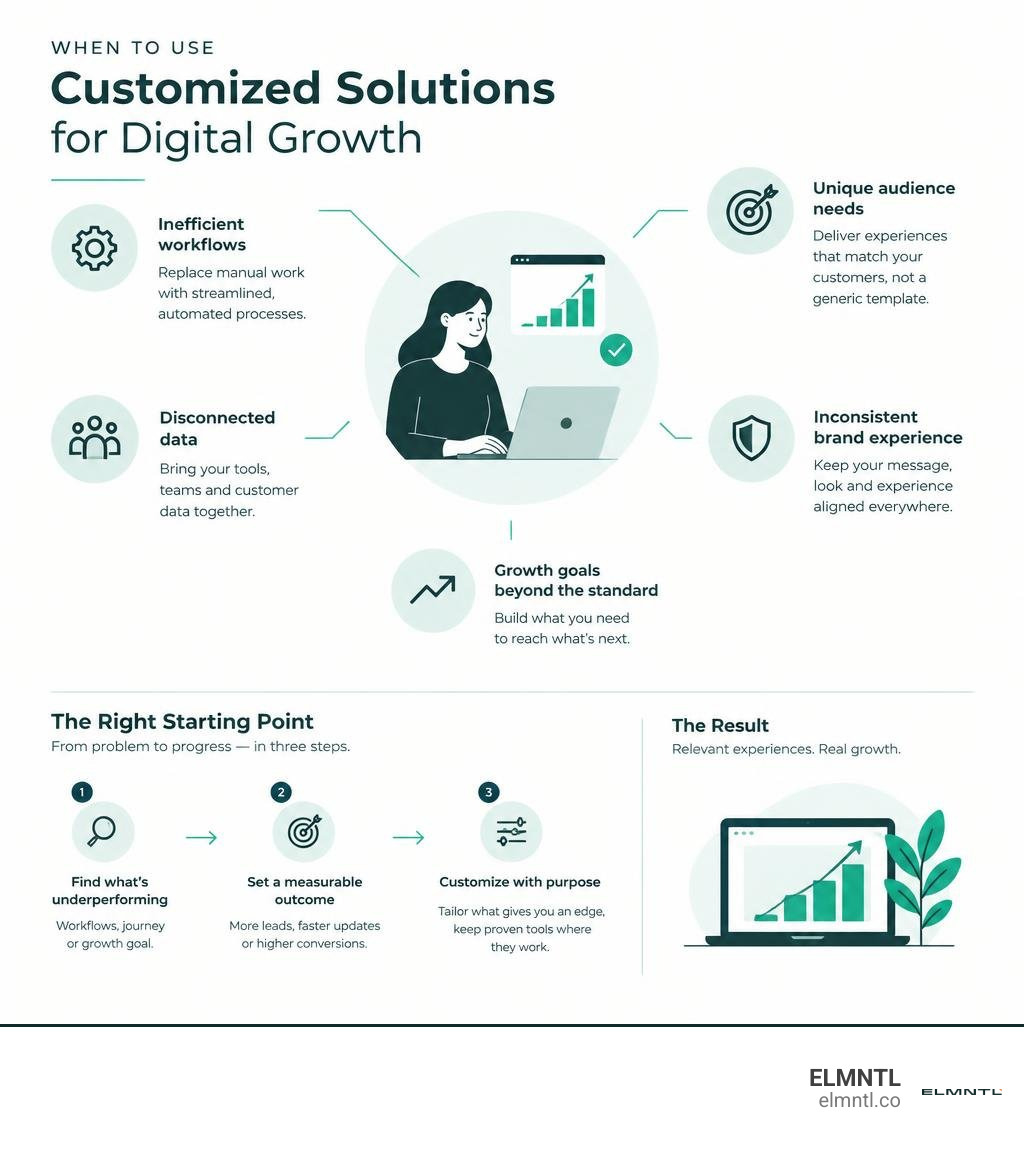
Customized solutions are products, services, or digital experiences designed around a specific business’s goals, workflows, audience, and constraints. They are the right choice when a standard platform creates manual work, weak brand consistency, disconnected data, or customer experiences that do not match how your organization actually operates.
For a growing brand, that can mean a website built around your sales journey, a campaign tailored to distinct audiences, or integrations that move data between marketing, CRM, and reporting tools without spreadsheet workarounds.
The practical starting point is simple:
- Identify the workflow, customer journey, or growth goal that is underperforming.
- Set a measurable outcome, such as more qualified leads, faster content updates, or higher conversion rates.
- Customize only what creates a clear advantage, while keeping proven tools and repeatable systems where they work.
This balance matters. A fully bespoke build can solve unique problems, but it should not add complexity for its own sake. The strongest customized solutions combine tailored strategy and design with scalable technology, clear governance, and measurable business results. For a broader view of how tailored approaches compare with standard platforms, see mass customization.
Strategic Drivers Behind Modern Customized Solutions
Organizations turn to bespoke builds when standard commercial platforms create friction instead of momentum. In modern business, efficiency and market distinction are closely linked. When operations rely on rigid templates, workflows slow down, customer experiences feel disconnected, and internal teams spend hours bridging technical gaps with manual tasks.

Understanding the business case for professional custom web design services starts with recognizing that digital touchpoints must reflect your distinct value proposition. A pre-packaged platform often forces your team to bend its proven processes around generic software limitations. In contrast, tailoring your digital ecosystem unlocks hidden operational efficiencies, turning digital channels from cost centers into active drivers of revenue.
Limitations of Off-the-Shelf Platforms
Standard commercial tools offer quick setups, but they frequently come with hidden long-term costs. As a business expands, generic platforms reveal distinct limitations:
- Rigid Data Schemas: Off-the-shelf software dictates how data must be structured, making it difficult to capture unique customer behaviors or specialized business metrics.
- SaaS Subscription Sprawl: Companies often purchase multiple point solutions to compensate for missing features, leading to high recurring license fees that exceed the cost of bespoke development over a three-year horizon.
- Workflow Friction: When software does not fit everyday operational needs, teams spend excessive time navigating awkward workarounds.
- Manual Spreadsheet Workarounds: Critical tasks frequently end up managed across disjointed spreadsheets, introducing human error and fragmenting data across departments.
Industry-Specific Demands Across Tech, Life Sciences, and Manufacturing
Generic platforms rarely satisfy the distinct operational demands of specialized industries. Across sectors, operational realities dictate unique technical foundations:
- Life Sciences and Biotechnology: Regulated environments require strict compliance, ISO 9001 and ISO 13485 quality standards, and specialized facilities. For example, reagent manufacturers manage specialized lyophilization facilities and require custom formulations free from components like BSA or glycerol to support high-throughput molecular diagnostics.
- Commercial Manufacturing and Conversions: In automotive and modular manufacturing, base platforms require specialized conversion architectures. Managing CAD data, technical drawings, and strict WLTP emission standards demands structured digital portals tailored to specific engineering workflows.
- Finance and Asset Management: Complex asset managers divide responsibilities across quantitative portfolio simulations and qualitative due diligence, requiring bespoke reporting engines that handle emerging ESG criteria alongside strict regulatory reporting.
Core Enablers of Rapid Bespoke Implementation
Modern development methodologies have transformed how bespoke solutions are built. Creating a tailored platform no longer requires months of planning before shipping code. By combining strategy-led planning with rapid iteration, organizations can launch production-ready tools quickly.
| Dimension | Off-the-Shelf Platforms | Tailored Digital Experiences |
|---|---|---|
| Workflow Fit | Forces operations into rigid templates | Engineered around your exact business logic |
| Data Ownership | Vendor-locked schemas and proprietary silos | Complete data control with custom connectors |
| Integration Agility | Limited to pre-built plugins | Direct API connections with CRM, ERP, and databases |
| Scalability | Tiered subscription costs increase with volume | Predictable architecture built for long-term growth |
| Brand Expression | Generic layouts and standard UI components | Distinctive design aligned with brand identity |
Strategy-Led Teams for Customized Digital Experiences
Achieving rapid results requires close alignment between strategic discovery and technical execution. Dedicated cross-functional teams partner directly with operational stakeholders to observe workflows firsthand, eliminating the disconnect between user needs and engineering output.
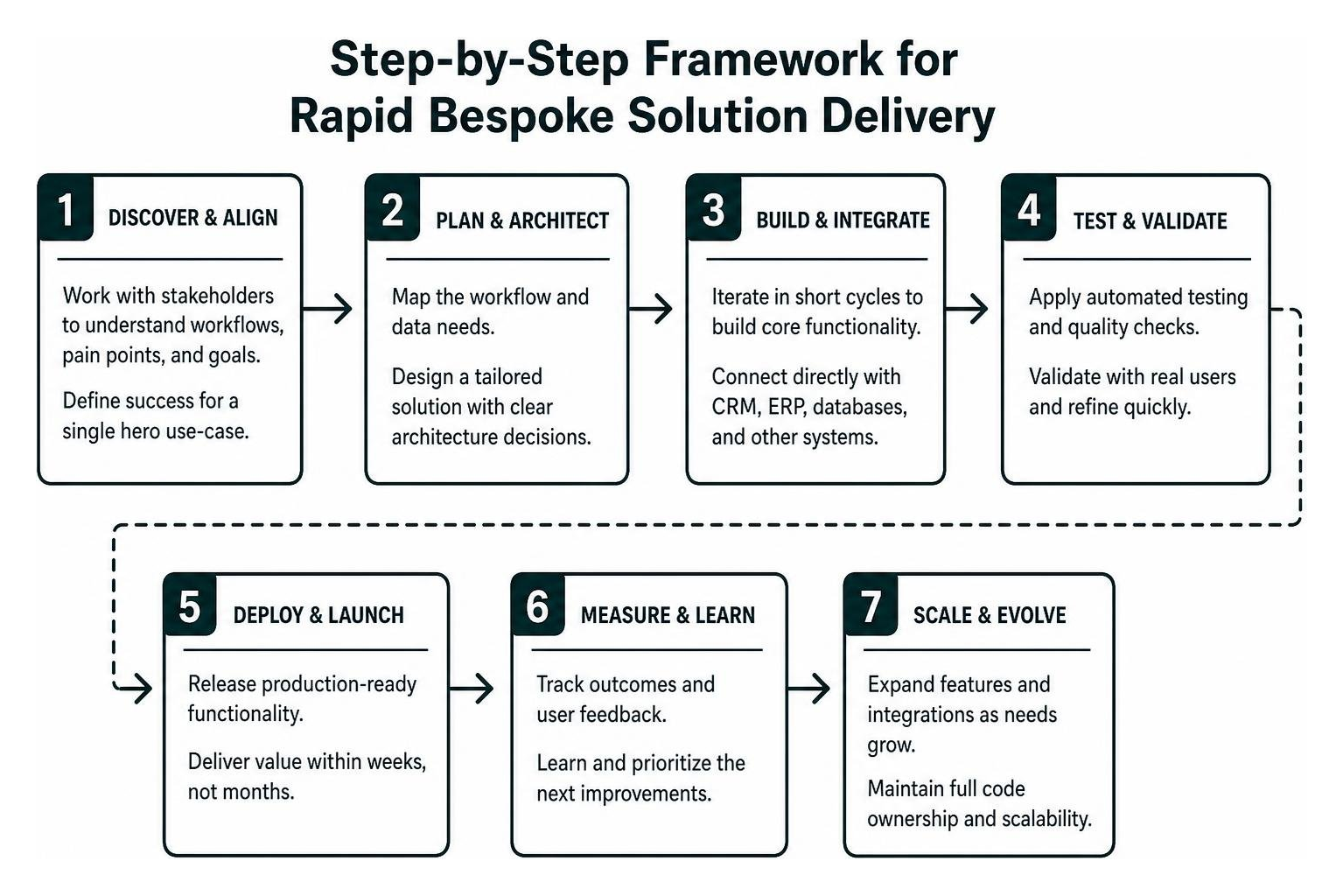
This approach focuses on a single hero use-case first. Instead of attempting a massive, multi-year deployment, teams validate an essential workflow in a focused sprint. By applying continuous integration, automated testing, and clear architecture decision records, companies can launch production-ready functionality within weeks while retaining full code ownership.
Modern Web and Digital Experience Tools
Modern web architectures make custom development far more agile than legacy software builds. Leveraging modular frameworks and flexible backends allows businesses to deliver responsive interfaces that adapt smoothly across desktop and mobile devices.
Building a scalable enterprise website ensures that your digital infrastructure handles increasing traffic and complex integrations without introducing operational bottlenecks. Modern user experience design also incorporates tools like interactive 3D configurators and intelligent search interfaces, enabling buyers to navigate complex product options naturally without needing manual intervention from sales representatives.
Digital Experience, Integration, and Governance
A bespoke build succeeds or fails based on how effectively it connects with existing enterprise systems. Rather than operating as an isolated island, a well-engineered platform communicates smoothly with databases, CRM platforms, ERP systems, and legacy infrastructure.

Reviewing our complete guide to custom CMS development reveals that enterprise content management must prioritize security, data governance, and modular content delivery. Custom systems allow companies to establish robust zero-trust security boundaries, protecting sensitive customer records and proprietary business data from unauthorized access.
Delivering Enterprise-Grade Customized Digital Experiences Without Technical Debt
To maintain long-term agility, bespoke builds must be designed with clean architecture principles. Rushing custom code without proper governance leads to technical debt, which can slow down future enhancements.
Sustainable engineering requires thorough documentation, automated code evaluation, and clear separation between data storage and business logic. Integrating website analytics, customer relationship data, and content management into a unified pipeline allows marketing teams to publish dynamic updates quickly while ensuring that all tracking and compliance protocols remain intact.
Structuring Partner Ecosystems and Tiered Access
For organizations that rely on dealer networks, certified converters, or integration partners, digital platforms must support multi-tiered access models. Structuring access into defined tiers (such as Registered, Integrated, and Premium partners) allows companies to share specialized assets efficiently:
- Asset Distribution: Partners gain structured access to technical CAD data, conversion guidelines, and brand marketing materials based on their tier.
- Workflow Collaboration: High-tier partners can submit joint proposals, co-brand marketing collateral, and access specialized technical configurators.
- Consistent Brand Standards: Standardized digital assets ensure that external partners maintain consistent brand identity and messaging across all touchpoints.
Frameworks for ROI Measurement and Risk Mitigation
Investing in tailored digital solutions requires clear financial justification. Organizations must evaluate both immediate cost savings and long-term business value to measure true return on investment.
Deploying website customization services that drive results involves establishing clear baseline metrics before development begins. Whether the objective is reducing bounce rates, improving conversion funnels, or eliminating manual data entry, quantifiable milestones keep teams accountable throughout the project lifecycle.
Measuring ROI and Mitigating Risks in Customized Solutions
To ensure customized investments deliver measurable business impact, organizations should track specific operational and financial metrics:
- Time-to-Value Benchmarks: Measuring how quickly a new workflow reduces cycle times for core tasks.
- Total Cost of Ownership (TCO): Comparing upfront development costs against multi-year SaaS licensing fees and platform add-on costs.
- Outcome-Based Delivery: Structuring engagements where a portion of project fees is tied directly to hitting predefined performance indicators, such as site speed, conversion lift, or lead generation targets.
- Observability and Monitoring: Implementing real-time tracing and analytics from day one to detect operational friction and monitor user engagement patterns.
Overcoming Common Pitfalls and Scope Creep
Bespoke projects can run into challenges if scope boundaries are poorly defined. A common pitfall is attempting to build every conceivable feature in the initial release.
To prevent scope creep, projects should follow spec-driven development with strict boundary definitions. Every proposed feature must directly serve the core business outcome. Human-in-the-loop validation, regular design reviews, and structured feedback loops ensure that development stays focused on real business priorities without inflating budgets or extending timelines unnecessarily.
Frequently Asked Questions About Tailored Implementations
How long does it typically take to deploy a bespoke solution?
Using modern modular frameworks, a production-grade initial release can be deployed in as little as six weeks. By scoping a clear hero use-case, development teams can build, test, and ship functional tools quickly, providing immediate value while secondary features are developed iteratively in subsequent sprints.
When should an organization choose custom development over commercial SaaS?
Custom development is ideal when your business processes provide a distinct competitive advantage that standard software cannot accommodate. If off-the-shelf platforms require multiple costly subscriptions, extensive manual data workarounds, or force you to compromise on data security and brand identity, a bespoke build is more cost-effective over the long term.
How do bespoke builds ensure data security and regulatory compliance?
Bespoke platforms are engineered to adhere strictly to your organization’s specific compliance requirements, such as GDPR, HIPAA, or ISO standards. By implementing role-based access control, zero data-retention policies where necessary, and encrypted data pipelines, custom builds keep sensitive business data completely within your control, avoiding the security risks associated with shared multi-tenant SaaS environments.
Conclusion
Building digital platforms that match your exact business operations creates a significant competitive advantage. While off-the-shelf tools have their place for generic tasks, relying on standard software for core business drivers often leads to fragmented data, frustrated teams, and disjointed customer experiences.
At ELMNTL, we combine 15+ years of digital marketing and technical expertise to design, build, and optimize high-performing digital platforms. Explore our tailored growth and digital transformation services to see how our team can help you streamline operations, strengthen your brand presence, and achieve measurable business results.