

Why Modern CRM Software Is Essential for Growing Companies
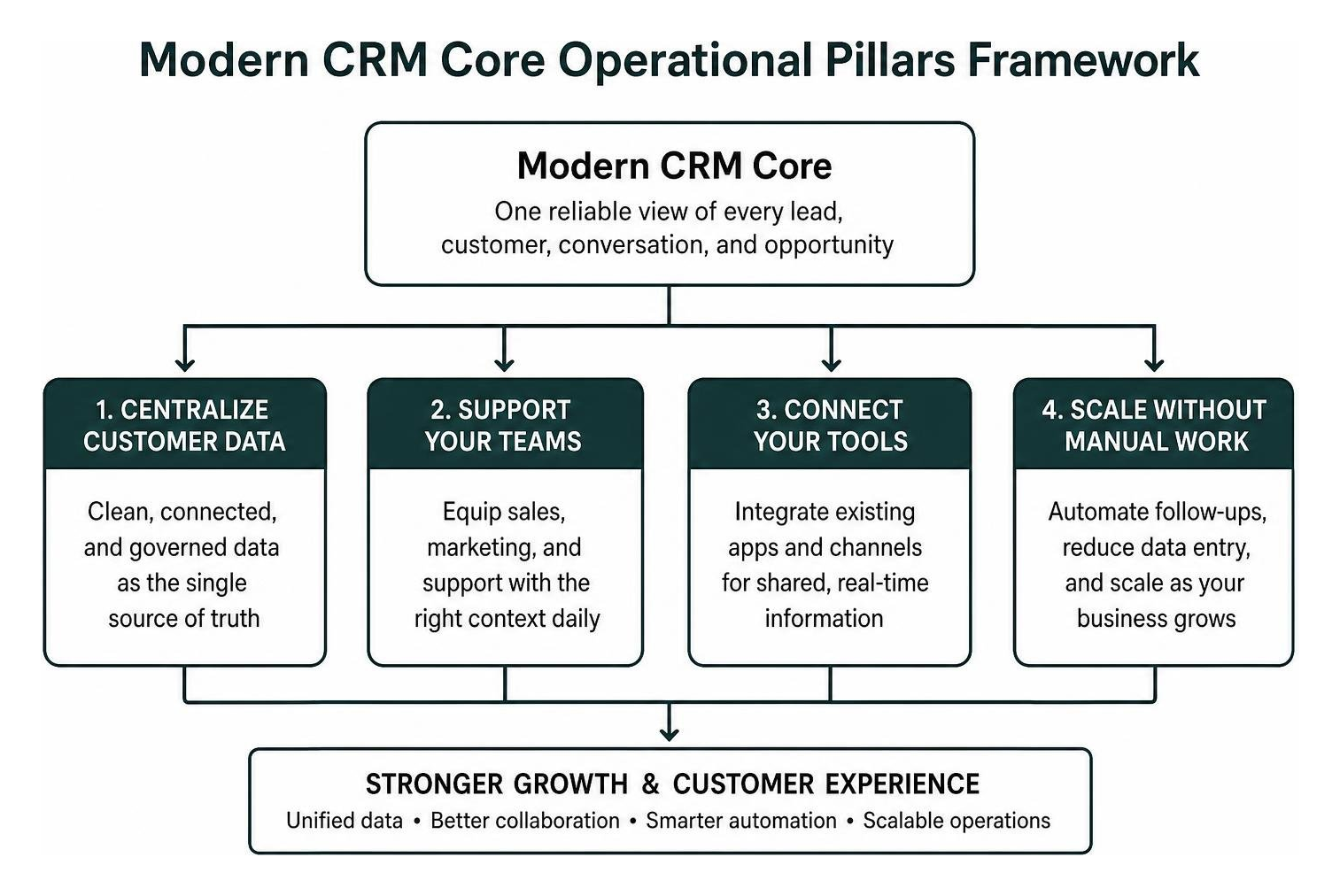
Choosing CRM software for your business comes down to four priorities: centralize customer data, support the teams who use it daily, connect your existing tools, and scale without adding manual work. The right system gives sales, marketing, and support teams one reliable view of every lead, customer, conversation, and opportunity.
Growing companies often outpace spreadsheets, disconnected inboxes, and stand-alone marketing tools. A modern CRM replaces that patchwork with shared data, automated follow-ups, clearer pipeline reporting, and a more consistent customer experience. This matters even more as organizations add apps, channels, and team members.
AI now makes CRM more useful by helping teams summarize interactions, draft outreach, prioritize leads, predict outcomes, and reduce repetitive data entry. But AI only works well when the underlying customer data is clean, connected, and governed.
I’m Ron Vernon, an entrepreneur, digital strategist, and marketing executive who has helped organizations turn growth plans into stronger digital experiences and measurable go-to-market results. My work with CRM software business strategy focuses on connecting brand, marketing, customer data, and conversion efforts so growing teams can scale with more clarity.
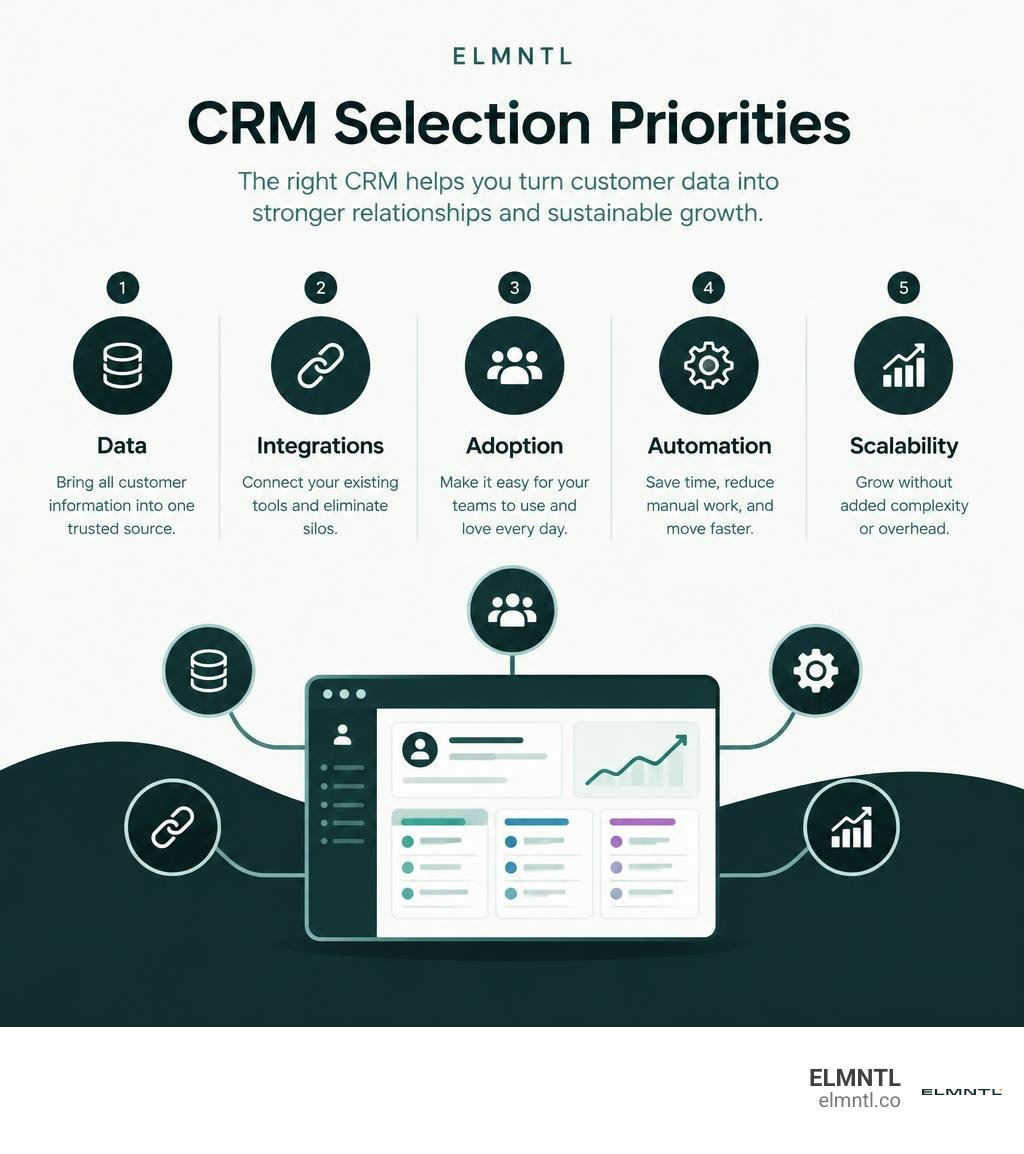
What Is Modern CRM and How Does It Drive Growth?
At its foundation, customer relationship management (CRM) software is a centralized digital engine designed to track leads, record customer interactions, and automate routine business processes across the buyer journey. As highlighted in Statista research on CRM market growth, enterprise software adoption continues to accelerate globally because centralized data infrastructure directly impacts operational velocity and bottom-line revenue.
When a company implements a full-featured CRM platform, the impact on key performance metrics is substantial. Industry benchmarks reveal that structured CRM adoption can yield an average return of $8.71 for every dollar spent, while boosting lead conversion rates by up to 300%. Centralizing customer records also increases customer retention rates by up to 47%, as teams gain the context required to prevent churn and foster long-term loyalty.
Rather than acting as a passive digital address book, modern CRM systems provide a complete 360-degree view of every buyer. This unified perspective links website analytics, email opens, past purchases, open support tickets, and direct sales calls into one continuous record.
Why Scalable Data Infrastructure Matters for Growing Organizations
The average organization today manages nearly 900 distinct applications across its various departments. When marketing tools, sales spreadsheets, support desks, and billing platforms operate in isolation, vital information slips through the cracks. Sales reps waste valuable selling hours manually hunting down contact history, while support agents lack the context needed to resolve client issues on the first touch.

A unified CRM platform acts as the definitive single source of truth for your entire enterprise. By consolidating customer touchpoints into a unified data model, organizations reduce administrative overhead, eliminate data entry redundancies, and ensure that every employee interacts with the same real-time information.
Core Pillars of a Modern CRM Software Business Framework
A successful CRM deployment relies on four core operational pillars: clean data governance, seamless pipeline management, cross-departmental collaboration, and predictive revenue intelligence. When these elements operate together, organizations can forecast quarterly revenue accurately, maintain strict data compliance, and break down friction between internal teams.
Aligning Sales and Marketing with CRM Software Business Solutions
Misalignment between marketing and sales teams often leads to wasted ad spend and lost pipeline revenue. Marketing generates leads that sales teams find unqualified, while sales teams abandon opportunities without providing actionable feedback to marketing.
Deploying a unified CRM bridges this divide by standardizing lead scoring and deal stage definitions. Marketing teams gain visibility into how closed-won revenue connects to specific campaigns, making it easy to build scalable lead generation strategies and evaluate multi-channel ROI. Marketers can build precision segments based on deal stages, lead behavior, or industry verticals using targeted audience segmentation.
With end-to-end attribution, marketing teams understand which touchpoints drive the highest customer lifetime value, while sales reps receive enriched contact records ready for personalized outreach.
Elevating Customer Support and Retention
Customer experience does not conclude when a contract is signed. Sustained profitability depends on ongoing client satisfaction, rapid ticket resolution, and proactive account management.
Modern CRM systems integrate service help desks, omnichannel live chat, and automated ticketing directly with sales records. When a customer reaches out via email, phone, or live chat, support specialists instantly see past order history, open opportunities, and specific service-level agreements (SLAs). This visibility allows support teams to resolve issues faster, boost customer satisfaction (CSAT) scores by up to 33%, and reduce overall service costs by 28%.
The Four Architectural Types of CRM Systems
Different organizations require distinct functional capabilities. CRM architecture is broadly categorized into four primary types, each tailored to specific operational priorities.
| CRM Architecture Type | Primary Business Focus | Core Functionalities | Best Suited For |
|---|---|---|---|
| Operational | Process automation and daily lead execution | Lead capture, sales pipeline stages, marketing automation, service ticketing | Fast-growing SMBs, transactional sales teams, service desks |
| Analytical | Data analysis, customer behavior, and reporting | Data mining, customer journey modeling, attribution, churn prediction | Enterprise data teams, multi-channel retailers, subscription businesses |
| Collaborative | Cross-department and external partner sync | Shared communications, partner portals, file sharing, centralized contact history | Multi-location teams, distributed workforces, channel sales ecosystems |
| Strategic | Long-term customer lifecycle value optimization | Customer experience management (CXM), relationship mapping, loyalty tracking | Account-based marketing (ABM) brands, enterprise relationship management |
Operational vs Analytical CRM Functions
Operational CRMs concentrate on streamlining day-to-day front-office execution. They automate repetitive administrative tasks, such as triggering automated email nurturing sequences when a form is submitted or routing inbound inquiries to the correct account executive.
Analytical CRMs focus on analyzing structured and unstructured data to guide strategic business decisions. They aggregate buyer behaviors across touchpoints, helping leadership identify conversion patterns by analyzing multi-channel traffic sources. While operational tools help teams execute daily tasks faster, analytical engines reveal which customer segments generate the highest margins over time.
Collaborative and Strategic Ecosystems
Collaborative CRMs eliminate internal communication friction by sharing customer data across billing, sales, marketing, and technical support. If a customer logs a critical service ticket, the sales account manager is notified automatically before dialing in for an account renewal conversation.
Strategic CRM ecosystems prioritize long-term relationship cultivation over short-term transaction volume. By monitoring customer satisfaction trends, feedback surveys, and product usage patterns, strategic platforms help organizations optimize customer lifetime value and build enduring brand advocacy.
How Agentic AI and Automation Transform Daily Operations
Artificial intelligence in modern CRM platforms has evolved beyond basic static chatbots and manual automation rules. Modern platforms utilize agentic AI, which introduces autonomous agents capable of researching accounts, qualifying inbound leads, summarizing meeting notes, and recommending next best actions.

According to global implementation benchmarks, embedding AI directly into CRM workflows yields a +35% increase in sales productivity, a +35% expansion in sales pipeline, and a +34% improvement in marketing ROI.
Autonomous Agents and Workflow Orchestration
Around 82% of businesses report that system integration represents one of their primary AI hurdles. Native CRM AI engines solve this by operating directly on the company’s existing customer records without requiring complex external data pipelines.
Autonomous agents can handle routine sales administration from end to end:
- Instant Lead Qualification: Evaluating inbound prospect criteria against ideal customer profiles (ICPs) in real time.
- Automated Data Enrichment: Appending company size, industry classification, and verified contact information to newly created records.
- Contextual Response Generation: Drafting customized email responses and follow-up templates based on previous customer interactions.
- Intelligent Meeting Summaries: Transcribing sales calls and instantly mapping action items into the pipeline.
By letting AI handle repetitive data entry, sales representatives can dedicate more time to relationship building and strategic deal negotiation.
Predictive Analytics and Intelligent Decision-Making
Modern CRM analytics engines evaluate historical transaction patterns to predict customer behavior accurately. By analyzing engagement frequency, email responsiveness, and ticket history, predictive lead scoring helps sales reps prioritize deals with the highest probability of closing.
Predictive capabilities also support proactive churn mitigation. When customer usage drops or service ticket frequency increases, the CRM alerts account managers to intervene before the account reaches a cancellation stage. Dynamic forecasting tools give executives reliable visibility into expected revenue, mitigating the risk of end-of-quarter surprises.
A Strategic Roadmap to Choosing and Implementing the Right CRM
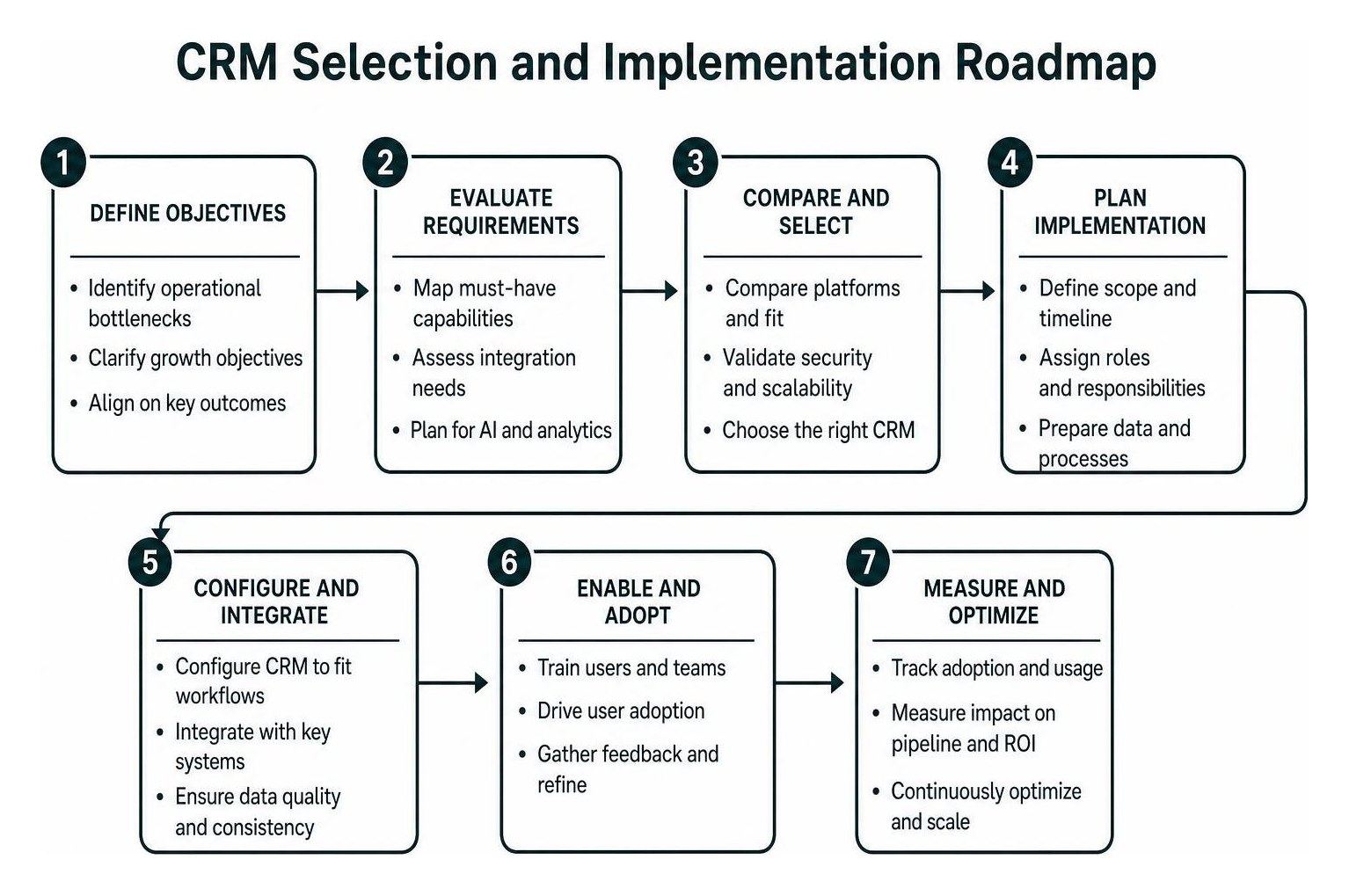
Choosing a CRM requires evaluating current operational bottlenecks, future growth objectives, and team adoption capabilities. A poorly planned implementation can cause low user adoption and fragmented records, whereas a structured rollout establishes a foundation for scalable growth.
Key Capabilities and Integration Requirements
When evaluating CRM software vendors, prioritize platforms that align with your business model and technical requirements:
- Centralized Pipeline Visibility: Configurable deal stages, visual Kanban boards, and real-time deal movement tracking.
- Marketing & Event Tracking: Built-in attribution for multi-channel campaigns, webinars, and live events to assess acquisition performance.
- Open API and Ecosystem Integrations: Native connectors for your existing email clients, billing tools, and customer databases.
- No-Code Customization: Composable workflows, custom property creation, and adjustable permission structures that do not require specialized developers.
- Enterprise-Grade Security: SOC 2 compliance, role-based access control, encryption standards, and strict adherence to GDPR and CCPA guidelines.
Evaluating Total Cost of Ownership for Your CRM Software Business Investment
Understanding the full financial commitment of a CRM implementation requires looking beyond the base monthly subscription tier. A comprehensive total cost of ownership (TCO) calculation includes several factors:
- Licensing and Seat Models: Tiered pricing based on user seats, contact storage volumes, or specific functional hubs (Sales, Marketing, Service).
- Data Cleansing and Migration: Extracting, formatting, deduplicating, and importing legacy customer data into the new platform schema.
- Third-Party Integration Costs: Premium middleware tools, custom API webhooks, or marketplace application add-ons.
- Internal Training and Change Management: Dedicated onboarding sessions and documentation to ensure high user adoption across all departments.
Organizations that properly plan for training, data hygiene, and phased workflow rollouts routinely achieve faster time-to-value and lower administrative costs.
Frequently Asked Questions About Business CRM Systems
What is the primary difference between a basic contact manager and a full CRM system?
A basic contact manager acts as an address book that stores names, phone numbers, and email addresses. A complete CRM system unifies pipeline stages, marketing automation, service ticketing, historical communication logs, reporting dashboards, and AI agents into a single operating platform.
How much should a growing company budget for CRM implementation?
Budget requirements depend on team size, data complexity, and required feature modules. Cloud-based CRM solutions generally range from $15 to $150 per user per month for small-to-midsize deployments, while advanced enterprise suites with custom automation and AI can range from $175 to over $500 per seat per month. Additional onboarding, migration, and training investments typically scale with organizational complexity.
How quickly can a company expect to see measurable ROI from CRM adoption?
Most businesses begin seeing measurable operational improvements within 60 to 90 days of complete onboarding. Initial wins often include reduced administrative time, faster lead response speeds, and clearer pipeline visibility. Broader financial returns, such as improved customer retention rates and higher win rates, typically materialize within two to three quarters as historical data accumulates.
Conclusion
A modern CRM is more than just a software tool. It serves as the operational backbone for sustainable business scaling. By centralizing scattered records into a single source of truth, automating routine workflows with agentic AI, and bridging data across sales, marketing, and support, your organization can build more meaningful customer relationships while accelerating revenue growth.
At ELMNTL, we help organizations navigate complex digital transformations by designing cohesive growth architectures that align branding, conversion strategies, and data systems. If your organization is ready to modernize its customer data infrastructure and accelerate go-to-market performance, explore our comprehensive marketing and growth services to build a scalable foundation for long-term success.