

How to Build a Customer Onboarding Journey That Keeps Customers
Customer journey onboarding works best when you start with the customer’s goal, define what their first success looks like, and remove anything that delays it. Give each customer a clear next step, offer help when they get stuck, and track how long it takes them to see value. Use what you learn to improve the journey and support long-term retention.
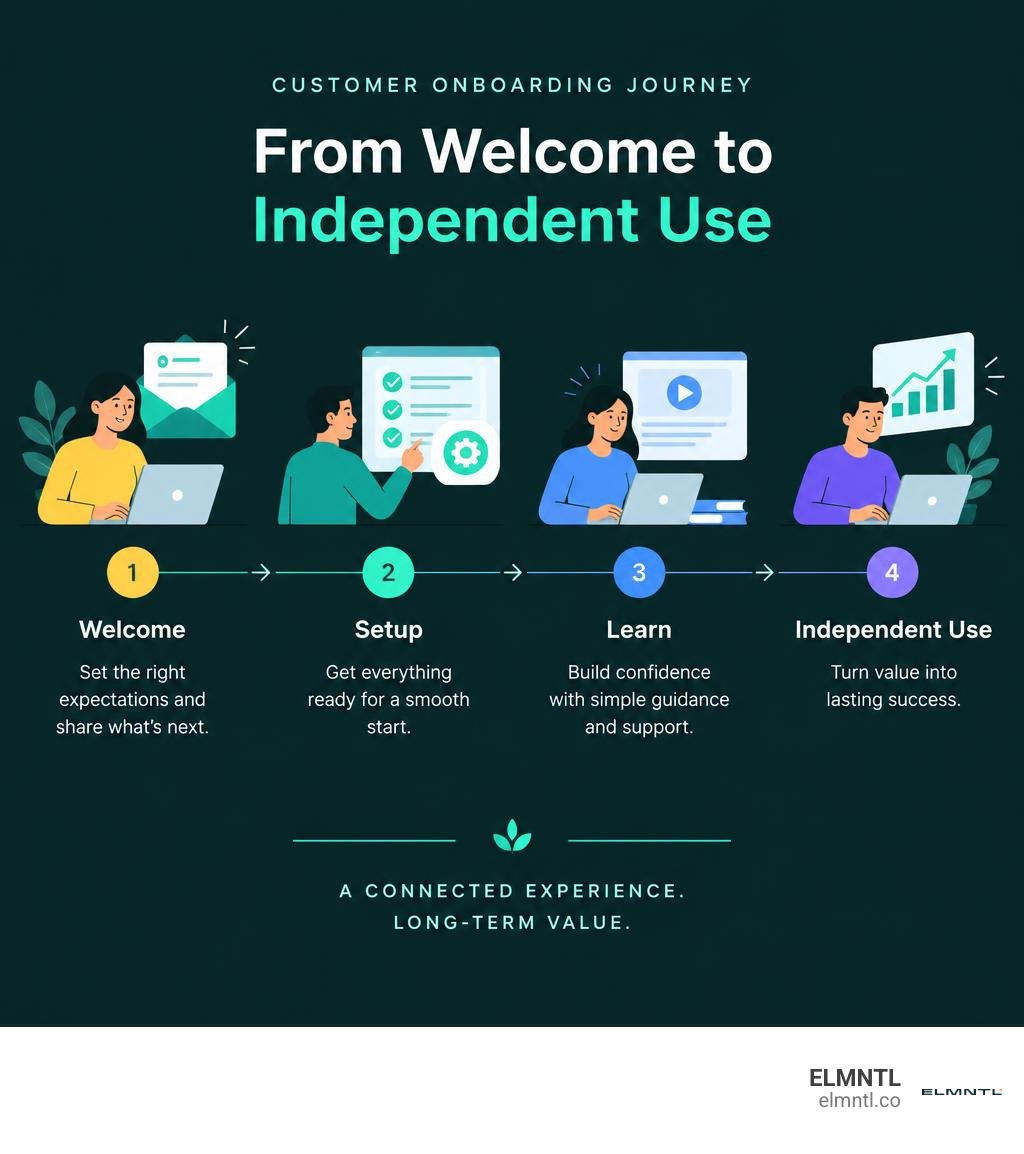
The experience should feel connected from the first welcome through setup, learning, and independent use. That takes shared ownership across sales, customer success, and support, not just a series of emails.
Discover more about customer journey onboarding:
Why Customer Journey Onboarding Dictates Long-Term Retention
Few moments in the customer lifecycle carry as much weight as those first days immediately following a conversion. Many businesses mistakenly treat the signed contract or completed checkout as the finish line, yet that transaction is merely the starting point. When customers step into an unfamiliar digital product or service environment, they experience heightened scrutiny and immediate expectations. If the post-purchase phase feels fragmented, complicated, or abandoned, customer churn spikes before adoption even begins.
Research shows that 86% of consumers are more likely to stay loyal to a company that invests in welcoming, educational onboarding content after a purchase. Conversely, poor initial experiences drive rapid disengagement: 50% of new users abandon mobile apps within the first month if they do not find immediate value, while 80% of users report deleting an app simply because they could not figure out how to use it. In physical and digital retail, 55% of people have returned a purchase because they did not understand how to use it properly.
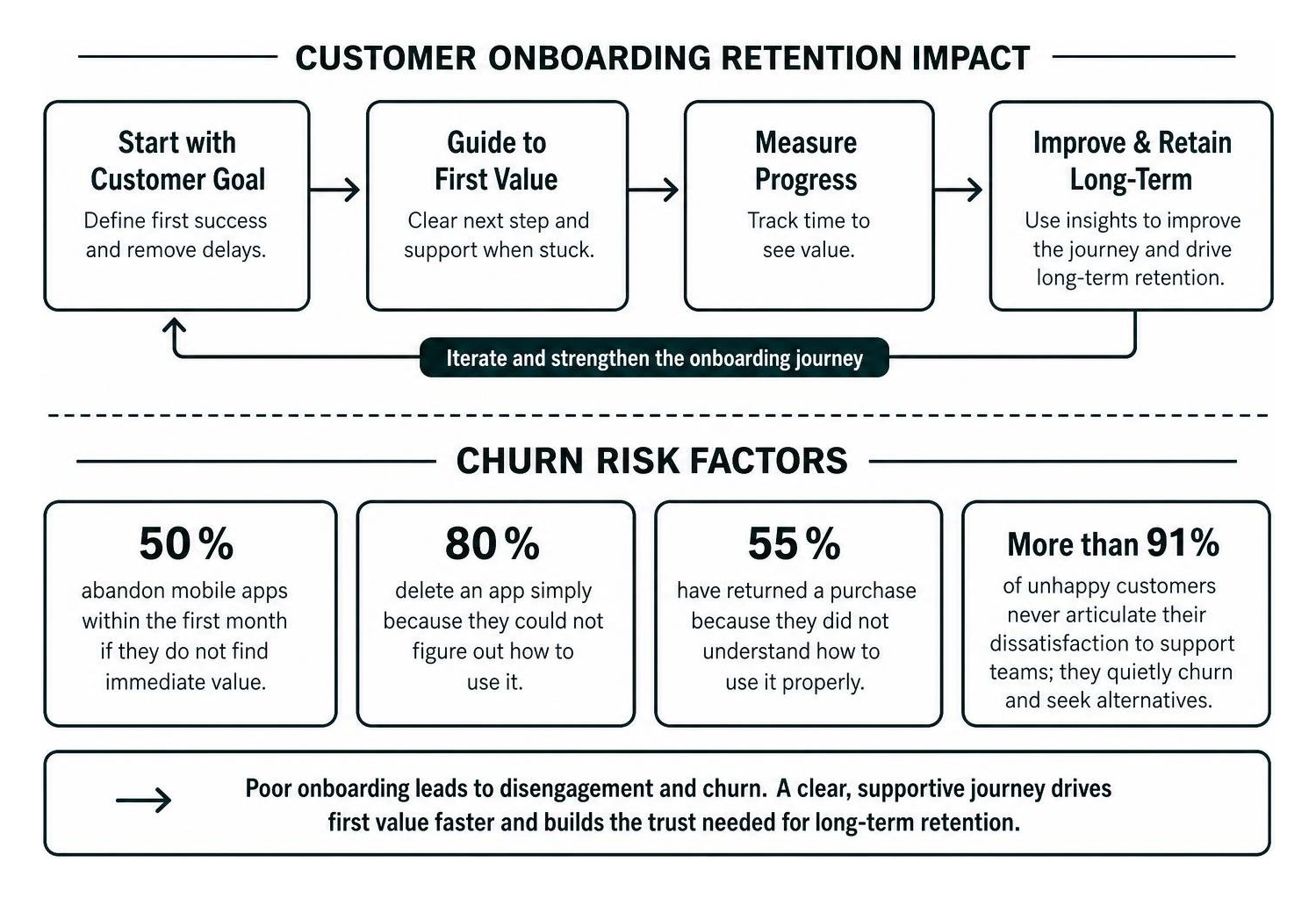
When we look at why mapping customer journey touchpoints transforms user experience, we see that onboarding bridges the gap between sales promises and real-world value realization. More than 91% of unhappy customers never articulate their dissatisfaction to support teams; they quietly churn and seek alternatives. Research from McKinsey highlights the importance of seeing the world through end-to-end customer journeys rather than isolated interactions. By treating onboarding as a cohesive journey, businesses protect initial acquisition spend, shorten time-to-value, and establish the trust necessary for sustainable expansion.
Defining the Activation Moment and Time-to-First-Value
The activation moment represents the precise threshold where a customer experiences the core value proposition of your product or service. This is often referred to as the “Aha!” moment. For an analytics tool, activation might occur when the first dashboard generates actionable business insights. For an ecommerce store, it could be the delivery of a seamless first reorder or personalized product setup guide.
Time-to-first-value (TTFV) measures the exact duration from the moment of purchase or signup to this initial achievement. Minimizing TTFV requires reducing cognitive load and cutting unnecessary friction. Digital onboarding studies reveal that the average abandonment point during registration workflows is 14 minutes and 20 seconds. If an onboarding flow exceeds 15 minutes, 55% of users abandon the process entirely; past 20 minutes, that abandonment rate climbs to 70%.
To avoid drop-off, companies must streamline early interactions, defer non-essential account configurations, and prioritize immediate wins. By strategically aligning marketing with the customer value journey, organizations ensure that onboarding workflows reinforce the exact expectations established during acquisition campaigns, guiding new users straight toward their core goals.
Aligning Cross-Functional Teams for Seamless Customer Journey Onboarding
Onboarding cannot succeed as an isolated responsibility of Customer Success Managers (CSMs). It requires cross-functional orchestration across every department that influences the client relationship:
- Sales and Account Executives: Capture user motivations, use cases, and technical constraints during discovery, passing context forward to eliminate repetitive questioning.
- Customer Success and Implementation: Translate sales data into tailored milestones, leading kickoff calls and configuring technical setups.
- Product and Education Teams: Design intuitive in-app UI guidance, knowledge base articles, and modular learning resources.
- Technical Support: Resolve early implementation roadblocks rapidly, monitoring support ticket trends to identify product UX bottlenecks.
- Executive Sponsors: Reinforce strategic alignment and secure cross-departmental buy-in for ongoing platform adoption.
When these teams operate with shared milestones and visibility, customer journey onboarding becomes a structured, predictable growth engine rather than a reactive scramble.
The Step-by-Step Blueprint for Mapping the Onboarding Journey
Mapping an onboarding user flow transforms an abstract onboarding concept into a clear operational standard. By developing a comprehensive visual blueprint, teams can pinpoint friction points, eliminate redundant steps, and orchestrate automated touchpoints alongside human interactions.

According to Harvard Business School’s analysis on customer journey map examples and processes, documenting each milestone gives teams an empathetic view of customer sentiment, potential hurdles, and necessary enablement resources. Utilizing a structured approach, like our complete guide to user journey mapping, allows product and success leaders to design an onboarding path that moves users smoothly from contract execution to self-sufficiency.
Mastering the Sales-to-Customer Success Handoff
The transition from sales to customer success is where customer sentiment is most fragile. About 70% of customers emphasize that connected internal processes are very important to winning and keeping their business. When a customer has to repeat their goals, tech stack specifications, or company background to an onboarding manager, confidence drops immediately.
To master this handoff:
- Standardize CRM Discovery Notes: Mandate clear fields for primary use cases, desired outcomes, key integrations, and target launch dates before deals move to closed-won.
- Conduct an Internal Pre-Handoff Briefing: Hold a brief alignment sync between the account executive and CSM to review nuances, potential organizational roadblocks, and executive sponsor dynamics.
- Deliver a Cohesive Kickoff Agenda: Send a joint welcome communication introducing the dedicated implementation team, outlining clear next steps, and attaching a pre-filled discovery summary for customer validation.
Kickoff, Configuration, and Progressive Account Setup
Once the kickoff is scheduled, the setup phase must balance speed with completeness. Forcing users to complete complex technical configurations all at once creates cognitive fatigue. Instead, modern onboarding uses progressive profiling and staggered setup stages.
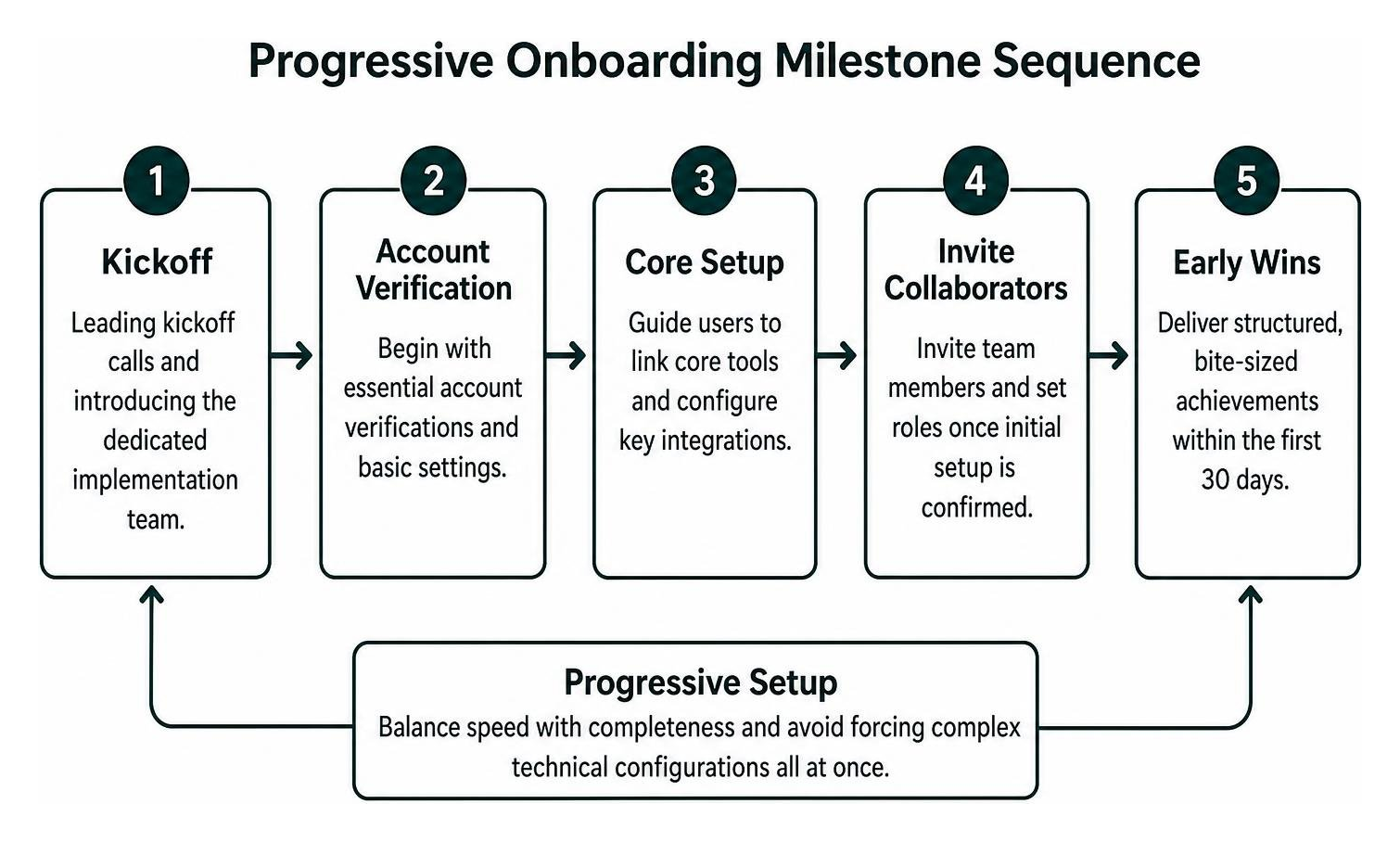
Begin with essential account verifications and basic settings, then guide users to link core tools or invite collaborators once initial setup is confirmed. Following essential website UX best practices guarantees that in-app setup screens, form fields, and administrative dashboards remain clean, accessible, and free of confusing technical jargon. Providing real-time visual progress bars and instant confirmations assures users that their setup is moving forward accurately.
Structuring Early Wins to Accelerate Adoption
Building adoption momentum depends on delivering structured, bite-sized achievements within the first 30 days of the relationship:
- Launch an Immediate Low-Effort Action: Prompt the customer to complete one simple, high-value task within the first 24 hours (such as importing a contact list or launching a pre-built template).
- Deploy Contextual Micro-Learning: Deliver targeted tutorials, short instructional videos, or interactive checklists at the exact moment a user navigates to a new feature.
- Celebrate Milestones Visibly: Acknowledge key setup completions with in-app celebration states, congratulatory emails, or automated summaries detailing time saved.
- Establish Proactive Checkpoints: Schedule brief review calls at Day 14 and Day 30 to review adoption data, answer workflow questions, and calibrate secondary objectives.
- Embed Continuous Feedback Loops: Trigger brief, single-question satisfaction surveys after milestone completions to catch frustration before it turns into disengagement.
Designing Scalable and Personalized Onboarding Experiences
As organizations grow, delivering white-glove, one-on-one onboarding to every single account becomes cost-prohibitive. The solution lies in designing a scalable onboarding architecture that personalizes the user experience through automation, behavioral segmentation, and role-based learning tracks.

By mapping user journey workflows, product teams can develop adaptive onboarding sequences that branch based on user role, company size, and stated objectives. An administrative user requires technical integration instructions and security permission controls, whereas an end-user needs practical, task-focused workflows that save them daily effort.
Tailoring Workflows for SaaS, Ecommerce, and B2B Services
Onboarding journeys naturally vary depending on business model, sales complexity, and customer touchpoints. The table below outlines how onboarding strategies adapt across different business environments:
| Business Model | Primary Onboarding Model | Key Activation Milestones | Communication Channels | Typical Timeframe |
|---|---|---|---|---|
| SaaS (Self-Serve & PLG) | Tech-Touch / Low-Touch | Account creation, core action completion, inviting team members | In-app tooltips, product tours, automated email triggers | 1 to 14 days |
| SaaS (Enterprise) | High-Touch / Hybrid | Data migration, API integration, role-based user training | Kickoff calls, dedicated CSM sessions, shared project portals | 30 to 90 days |
| Ecommerce | Automated / Tech-Touch | Order tracking confirmation, unboxing guide, first repeat browse | Transactional email, SMS notifications, packaging inserts | 1 to 7 days post-delivery |
| B2B Professional Services | High-Touch | Discovery audit, roadmap sign-off, stakeholder alignment | Face-to-face workshops, weekly status reviews, executive briefings | 30 to 60 days |
For high-volume digital environments, low-touch and tech-touch motions rely heavily on event-driven automation. For enterprise B2B engagements, digital portals work alongside dedicated consultants to maintain project visibility and accountability.
Leveraging Automation and Learning Management Systems
Integrating modern technology platforms allows companies to scale education without sacrificing engagement. Deploying a customer-facing Learning Management System (LMS) or interactive knowledge base centralizes training, enabling customers to master complex features at their own pace.
Platforms like Adobe Journey Optimizer demonstrate how building multi-channel customer onboarding journeys with automated email and SMS triggers keeps users engaged based on real-time app interactions. Similarly, customer success teams leverage structured customer lifecycle journey frameworks to automate internal task generation, track account-level health scores, and trigger targeted interventions whenever an account stalls during onboarding.
Using micro-learning modules (under three minutes each) increases knowledge retention by up to 80% compared to traditional, hours-long training webinars. Combining interactive in-app guides with automated re-engagement workflows ensures that inactive users are gently guided back to their next logical action.
How to Measure and Optimize Onboarding Workflows
Continuous optimization is what separates world-class onboarding programs from stagnant ones. A static onboarding strategy quickly becomes obsolete as your product evolves, user demographics shift, and new features roll out.
To maintain efficiency, leaders must continuously audit drop-off data, monitor onboarding health indicators, and run controlled experiments to refine touchpoints.
Key Metrics to Measure Customer Journey Onboarding Success
To evaluate onboarding effectiveness, track a balanced mix of velocity, completion, and sentiment metrics:
- Time-to-First-Value (TTFV): The number of hours or days required for a new customer to achieve their first tangible product milestone.
- Onboarding Completion Rate: The percentage of enrolled accounts that successfully finish all mandatory setup and training stages.
- Activation Rate: The proportion of signups or buyers who trigger core usage behaviors within a defined initial window (e.g., Day 7 or Day 30).
- Customer Effort Score (CES): A post-onboarding survey metric measuring how easy or difficult it was for the customer to complete setup on a 1-to-7 scale.
- Net Promoter Score (NPS) and CSAT: Early customer satisfaction benchmarks collected immediately after initial onboarding sign-off.
- Cohort Retention Rates: Day 30, Day 90, and Year 1 retention rates of customers who completed standard onboarding compared to those who dropped off early.
Common Mistakes to Avoid in Onboarding Workflows
When mapping and refining onboarding journeys, teams often run into predictable traps that harm adoption:
- Information Overload: Forcing users through lengthy, mandatory 20-step tours on their first login. This overwhelms users and causes immediate drop-off.
- Relying on Rigid Calendar Schedules: Triggering automated onboarding emails based on arbitrary calendar days (e.g., “Day 3 Email”) rather than real-time user behavior. Communications should respond to what the user has or has not done.
- Treating Journey Maps as One-Off Exercises: Creating a journey map during an annual strategy session and shelving it. Onboarding maps must function as living operational documents, updated regularly using adoption data.
- Ignoring Warning Signals: Failing to establish automated alerts for accounts that display zero logins or incomplete integrations within their first week.
- Neglecting the Human Element: Over-automating to the point where frustrated users cannot easily access live support or an implementation guide when facing roadblocks.
Frequently Asked Questions About Onboarding Journeys
What is the difference between customer onboarding and user onboarding?
User onboarding focuses narrowly on the end-user’s in-product experience, guiding them through feature mechanics, UI navigation, and technical configurations. Customer onboarding encompasses the entire post-sale relationship, including executive alignment, multi-stakeholder training, billing handoffs, ongoing communication channels, and overall business value realization.
How long should the customer onboarding process take?
The timeline depends heavily on product complexity and business model. For lightweight, self-serve SaaS and ecommerce products, onboarding should guide users to initial value within minutes to a few days. For complex enterprise SaaS, fintech implementations, or B2B professional services, onboarding typically spans 30 to 90 days to accommodate technical integrations, security audits, and comprehensive team training.
How do you identify drop-off points during onboarding?
Drop-off points are identified by pairing quantitative product analytics with qualitative user feedback. Funnel analysis reports pinpoint the exact setup steps or screens where progress stalls. Supplementing funnel data with session replays, support ticket volume analysis, and short in-app exit surveys reveals whether abandonment is driven by technical bugs, confusing UI, or unnecessary form fields.
Conclusion
Designing a high-performing onboarding journey is one of the most effective ways to lower churn, improve customer lifetime value, and build competitive differentiation. By setting clear activation goals, aligning cross-functional teams, and balancing automated efficiency with targeted human support, businesses can turn first-time purchasers into long-term brand advocates.
At ELMNTL, we help businesses build connected customer journeys that drive measurable growth across every digital touchpoint. If you are ready to modernize your digital customer experience, explore ELMNTL integrated digital marketing and strategy services to build end-to-end journey systems that turn early engagement into lasting retention.