

Why Customer Journey Touchpoints Matter
A touchpoint in the customer journey is any moment a person encounters your brand, from a search result or review to a website visit, purchase, or support call. Mapping these moments shows where people get confused, lose trust, or give up. It also shows where a better experience could help them move forward.
The key is to look beyond each interaction on its own. A clear ad cannot make up for a confusing website, and a smooth checkout means less if support is hard to reach. This guide shows how to find your touchpoints, connect them into a journey, and decide what to improve first.
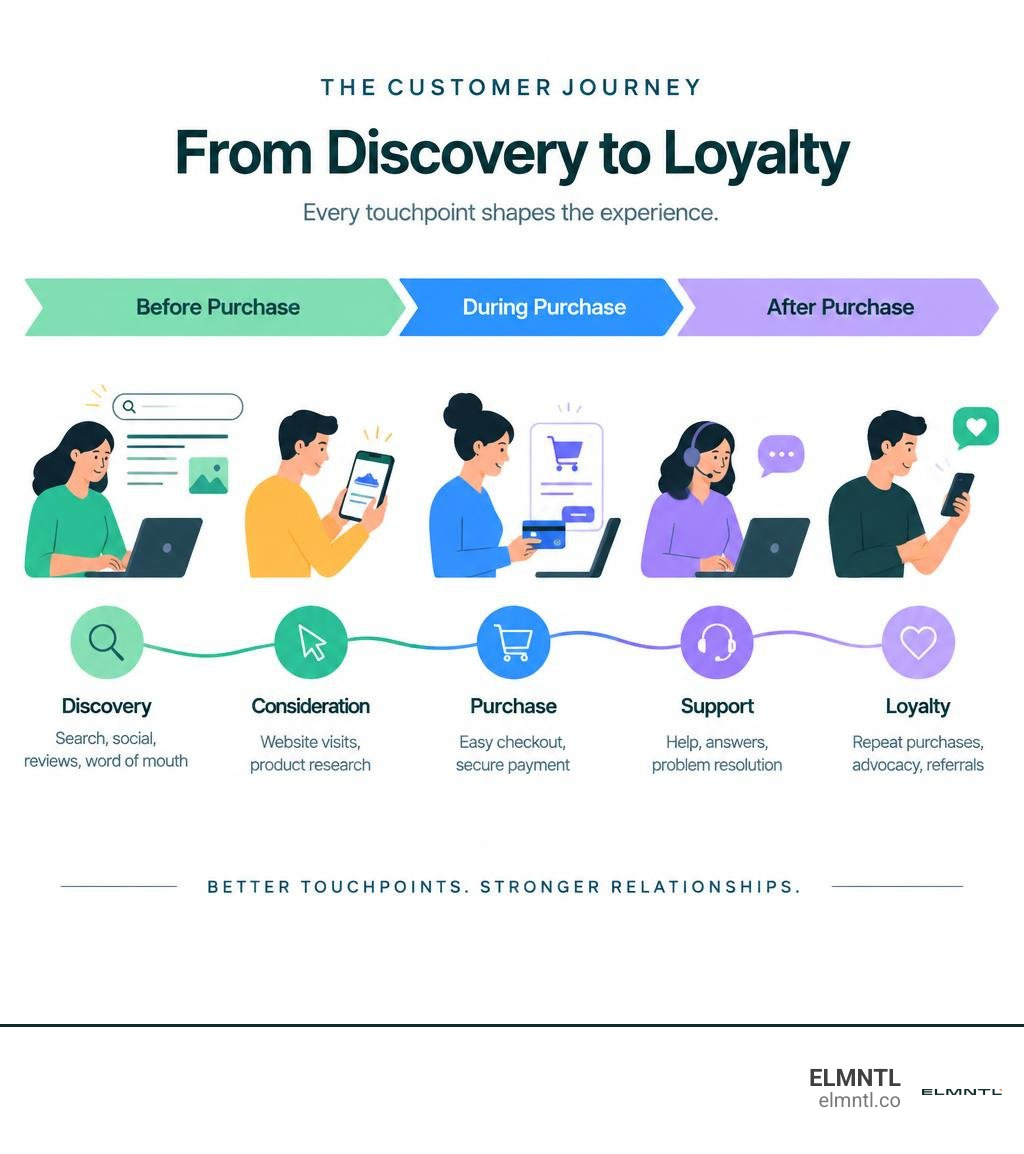
Touchpoint in customer journey vocab to learn:
What Is a Touchpoint in the Customer Journey?
Every time a potential or existing customer comes into contact with your brand, whether directly through your website or indirectly through an external review site, an impression forms. These discrete micro-moments determine customer perception, brand sentiment, and long-term loyalty. When we view these interactions systematically, we see that customer satisfaction is not built on a single grand gesture. It is earned through dozens of reliable, well-orchestrated moments.
Understanding these touchpoints is essential for sustainable growth. Research indicates that the three journeys that matter most to customers account for more than 25% of total customer satisfaction. Furthermore, in measurements of customer satisfaction with the most important journeys, a one-point improvement on a ten-point scale corresponds to at least a three-percentage-point increase in the revenue-growth rate. By clarifying how people engage with your business across their entire lifecycle, as explored in academic research on customer journeys, companies can eliminate friction points that quietly drain revenue.
Defining Every Touchpoint in Customer Journey Mapping
In practice, a customer journey touchpoint represents any point of exchange between a user and an organization. This includes digital touchpoints like social ads, organic search listings, automated onboarding sequences, and chat widgets, as well as physical interactions such as in-store visits, packaging unboxing, product events, or phone calls with customer support.
When you conduct comprehensive user journey mapping, you document not just the occurrence of these interactions, but the underlying customer emotions, motivations, questions, and hurdles at each step. Every single interaction contributes to customer sentiment. If an ad promises simple software setup, but the subsequent welcome email links to a broken knowledge base, the positive momentum vanishes instantly.
Touchpoints vs. Channels vs. Stages: Key Distinctions
It is common to confuse touchpoints with channels and journey stages, but distinguishing them is vital for effective strategy:
- Journey Stage: The overarching phase of the customer lifecycle (e.g., Awareness, Consideration, Purchase, Retention, Advocacy).
- Channel: The communication medium or environment where an interaction happens (e.g., website, email, retail store, social platform, phone).
- Touchpoint: The specific event or interaction driven by customer intent within a channel at a given stage (e.g., reading a product review, submitting a support ticket, opening a shipment confirmation email).
| Concept | Definition | Purpose | Common Examples |
|---|---|---|---|
| Stage | A broad phase in the customer lifecycle | Organizes the buyer’s mindset and progression | Awareness, Consideration, Decision, Retention |
| Channel | The platform or medium used for communication | Houses and delivers touchpoints | Organic search, Email, Mobile App, In-Store, SMS |
| Touchpoint | A specific interaction between user and brand | Fulfills an immediate user need or intent | Reading an FAQ, downloading an ebook, live chatting |

Core Types of Customer Touchpoints Across the Buyer Lifecycle
To manage touchpoints effectively, we categorize them into three key phases: pre-purchase, purchase, and post-purchase. This lifecycle structure ensures that marketing, sales, product, and support teams align around shared customer outcomes.
Pre-Purchase Touchpoints: Building Awareness and Trust
Pre-purchase touchpoints occur while prospective buyers research options, form impressions, and narrow down their choices. These interactions establish your brand credibility before a prospect ever speaks to sales or adds an item to a cart.
- Organic Search & SEO: Informational blog posts, landing pages, and search snippets that answer top-of-funnel questions.
- Social Media & Influencer Content: Educational videos, community discussions, and peer mentions introducing your brand narrative.
- Online Reviews & Ratings: Third-party validation on review portals. With 89% of consumers worldwide reading reviews before buying a product, external feedback serves as a decisive touchpoint.
- Digital Advertising: Targeted search, display, and social ads addressing specific pain points.
To build meaningful connections early, you must conduct qualitative research for journey mapping to uncover what information buyers need before making a decision.
Purchase Touchpoints: Streamlining Decision and Conversion
Purchase touchpoints represent the moments where high intent turns into action. Any unnecessary friction here immediately inflates drop-off rates and abandoned carts.
- Product Pages & Demos: Interactive product tours, clear pricing tiers, transparent feature comparisons, and high-resolution imagery.
- Checkout & Payment Forms: Streamlined forms with minimal required fields, multiple payment gateways, and explicit security badges.
- Sales Calls & Live Chat: Real-time assistance that answers specific technical or commercial questions.
Ensuring these touchpoints operate smoothly requires ongoing website customer journey analysis to spot technical bottlenecks, slow page load times, or confusing form fields that cause buyers to abandon their purchases.
Post-Purchase Touchpoints: Driving Retention and Loyalty
The customer experience does not end when payment clears. Post-purchase touchpoints dictate whether a buyer becomes a repeat client and vocal advocate or churns silently.
- Order Confirmations & Tracking: Immediate, informative communication detailing what happens next.
- Onboarding & Welcome Workflows: Step-by-step product walkthroughs, activation checklists, and setup guides.
- Customer Support & Knowledge Bases: Fast, empathetic problem resolution via chat, phone, or comprehensive help documentation.
- Check-Ins & Loyalty Perks: Proactive account reviews, milestone celebrations, and exclusive rewards.
Focusing on these interactions yields substantial dividends. A 5% increase in customer retention can produce more than a 25% increase in profit. Strategic teams actively use journey mapping for customer loyalty to turn routine service moments into opportunities for lasting retention.
Why Moving from Individual Touchpoints to End-to-End Journeys Matters
A common organizational pitfall is managing touchpoints in isolation. Marketing optimizes the ad click, web teams optimize page views, sales focuses on close rates, and support tracks average handle time. While every department reports green metrics, the overall customer experience can still be disjointed and frustrating.
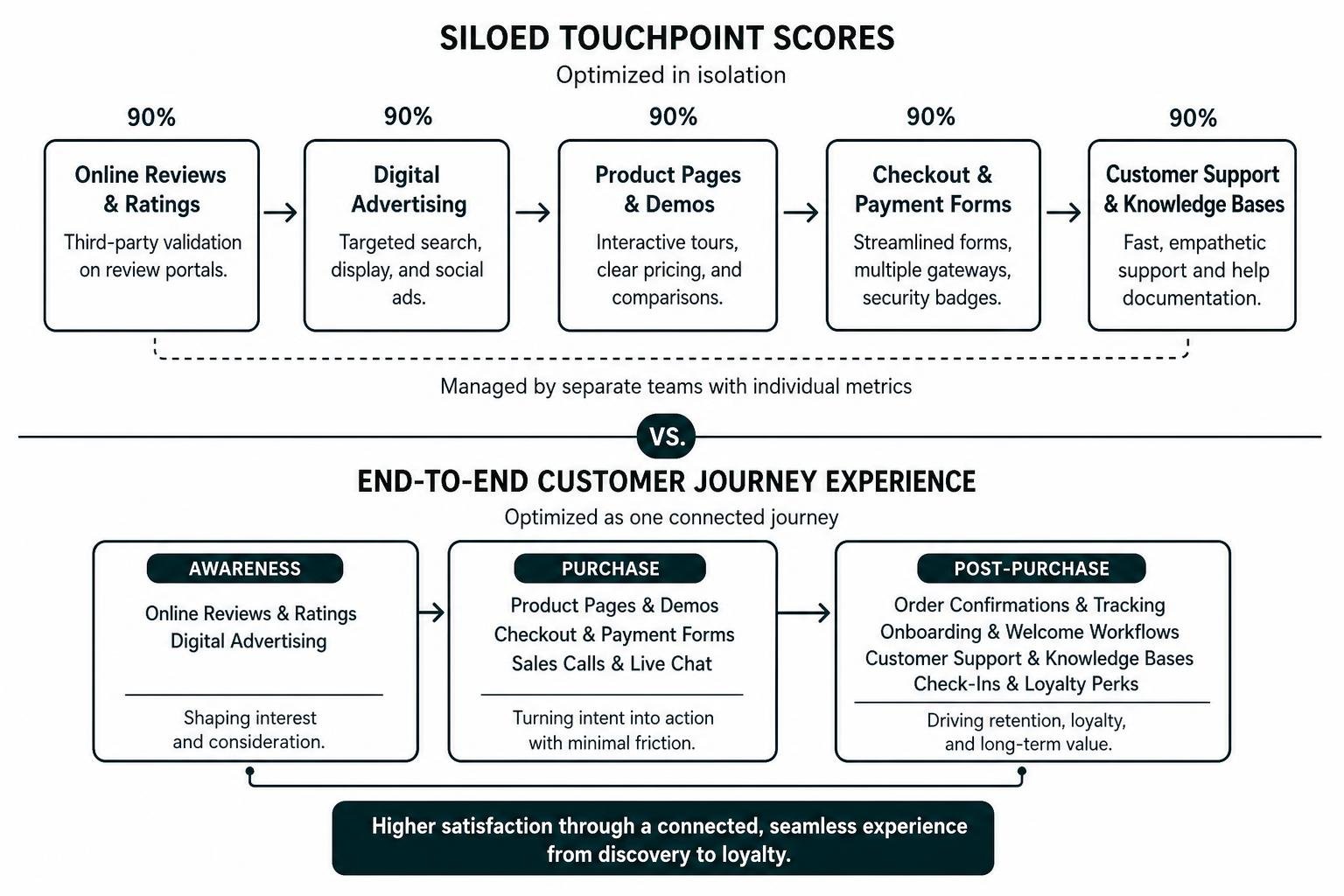
The Cumulative Impact of a Touchpoint in Customer Journey Performance
When companies focus solely on individual interactions, they develop operational blind spots. A customer might have five pleasant, 90%-satisfaction interactions across phone, email, and web chat. However, if they were forced to contact the company five separate times to solve a single issue, their cumulative journey experience is exhausting.
Research on end-to-end customer journeys demonstrates that managing the complete experience rather than isolated transactions produces significantly higher business performance. When organizations break down internal departmental silos, they eliminate redundant steps, reduce customer effort, and drive sustainable revenue growth.
Identifying “Moments of Truth” Across Critical Paths
Not all touchpoints carry equal weight. In every industry, specific high-stakes interactions dictate whether a customer stays or leaves. These critical paths are known as “Moments of Truth.”
For instance, in B2B SaaS, the 48-hour onboarding activation window represents a moment of truth; users who complete their first core workflow within two days retain at dramatically higher rates. In financial services, the period of silence between submitting a loan application and receiving an update is a moment of truth where anxiety peaks. Identifying and perfecting these decisive junctures allows businesses to deploy their resources where they prevent churn and preserve trust most effectively.
How to Identify, Map, and Optimize Your Brand Touchpoints
Transforming your customer experience requires a structured, data-driven methodology. Here is how we recommend finding, analyzing, and refining your brand touchpoints.
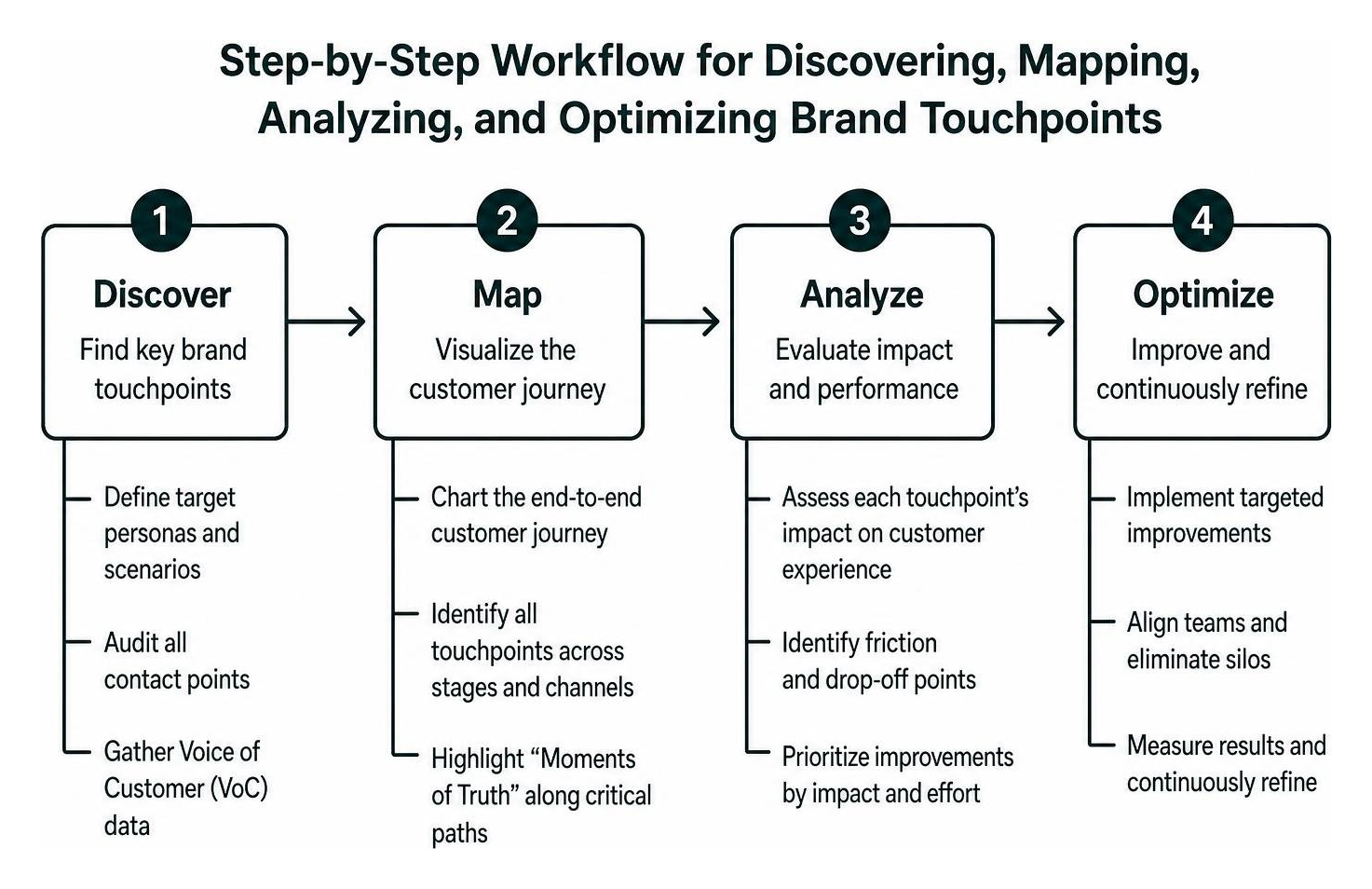
Step-by-Step Touchpoint Discovery and Data Collection
- Define Target Personas and Scenarios: Select a specific customer segment and their primary objective (e.g., a mid-market buyer evaluating software).
- Audit All Contact Points: List every channel and asset across marketing, sales, product, billing, and customer service.
- Gather Voice of Customer (VoC) Data: Collect feedback through surveys, user interviews, support transcripts, and public review sites. 76% of consumers will leave a review if asked, giving you direct insight into their lived experience.
- Analyze Operational and Behavioral Metrics: Review Google Analytics, heatmaps, CRM activity logs, and call center notes to validate user drop-off points.
- Visualize the Connected Flow: Map touchpoints chronologically, documenting customer emotions, operational owners, and technology systems at each stage. Learn more about visualizing touchpoints that convert to make these diagrams actionable.
Prioritizing Touchpoint Improvements for Maximum ROI
Once you have documented every interaction, you will likely discover dozens of potential adjustments. To avoid spreading resources too thin, prioritize updates using a simple Impact vs. Effort matrix:
- Quick Wins (High Impact, Low Effort): Removing unnecessary form fields on sign-up pages, fixing broken links in automated welcome emails, or replying to negative reviews. When you do not respond to reviews, you risk increasing customer churn by 15%.
- Strategic Investments (High Impact, High Effort): Redesigning a multi-step checkout workflow, deploying an omnichannel customer portal, or revamping product onboarding.
- Low Priorities (Low Impact, Low Effort): Minor visual tweaks to secondary content pages.
- Time Sinks (Low Impact, High Effort): Over-engineering custom internal tools for edge-case touchpoints that rarely occur.
Track your progress by monitoring core CX metrics like Customer Effort Score (CES), Net Promoter Score (NPS), and stage-to-stage conversion rates before and after each release.
Leveraging AI and Personalization to Enhance Touchpoints in 2026
Modern customer expectations demand seamless, context-aware interactions. Today, artificial intelligence enables organizations to deliver dynamic personalization across digital and human touchpoints at scale.

By deploying predictive analytics, brands anticipate user intent before friction arises. For instance, AI algorithms can recognize when a user is struggling on a complex checkout page and trigger a proactive, context-aware chat assistant with relevant answers. Similarly, natural language sentiment analysis monitors customer service tickets and social channels in real time, alerting account managers to at-risk clients before dissatisfaction turns into churn.
Personalizing touchpoints means connecting your customer data across every channel. When an agent answers a support call with complete visibility into the customer’s recent website visits, purchase history, and marketing preferences, the customer never has to repeat themselves. Ensuring your systems communicate effectively is essential when aligning marketing and customer experience.
Frequently Asked Questions About Customer Touchpoints
How do you measure the effectiveness of a single touchpoint?
Evaluate touchpoints using a combination of micro-metrics and holistic feedback:
- Conversion and Drop-Off Rates: The percentage of users who complete the desired next step from that interaction.
- Customer Effort Score (CES): A simple post-interaction survey asking how easy it was to complete their task.
- Customer Satisfaction (CSAT): Immediate sentiment ratings gathered right after support, checkout, or onboarding events.
- Operational Metrics: Page load speed, average handle time, or form completion duration.
What is the difference between direct and indirect touchpoints?
Direct touchpoints are brand-owned and controlled channels where you dictate the messaging and experience, such as your website, retail store, email newsletters, product packaging, and customer service teams.
Indirect touchpoints occur through third parties outside your direct control, such as customer reviews, influencer mentions, word-of-mouth recommendations, news coverage, and social media discussions. While you cannot fully control indirect touchpoints, you can influence them by delivering reliable service, monitoring mentions, and actively responding to feedback.
How often should businesses update their touchpoint mapping?
Customer journey mapping is an ongoing management practice, not a one-time project. We recommend:
- Quarterly Reviews: Audit high-impact touchpoints and key conversion funnels against current analytics and VoC data.
- Major Milestone Updates: Re-map journeys whenever you launch a new product, enter a new market, adjust your pricing model, or undergo brand repositioning.
- Continuous Monitoring: Maintain real-time tracking for critical metrics like checkout conversion, churn indicators, and review sentiment.
Conclusion
Every customer interaction shapes how buyers perceive your brand, whether they choose to purchase, and how long they stay. By identifying your key touchpoints, resolving friction across critical paths, and connecting individual interactions into a cohesive end-to-end journey, you build an experience that fosters customer loyalty and sustainable revenue growth.
To build an integrated web experience, modernize your brand positioning, or optimize your conversion funnels, explore our digital marketing and strategy services to turn your customer journey into a measurable competitive advantage.